

Recently, The Guardian highlighted growing concerns about the role of Big Tech companies such as Google, Amazon, Microsoft, IBM and Alibaba in digital agriculture. Working alongside large agribusiness input providers, these firms are developing AI-driven tools that could influence what crops are grown and how.
At stake is not only the future of digital agriculture, but control over what I call the “intelligence layer” of agriculture: the data systems, AI models and algorithms that increasingly guide farming decisions.
As agriculture becomes more data-driven, the actors who control this intelligence layer will shape what crops are grown, how inputs are used and how farming risks are managed.
A structural shift is underway in agriculture. Historically, power in agricultural value chains was concentrated in three places: input suppliers, traders and food processors. Today, a new layer is emerging above them: digital systems that analyse agricultural data and generate recommendations for farmers. This intelligence layer is becoming a critical point of influence in farming systems.
The article references the recent report “Head in the Cloud” by the International Panel of Experts on Sustainable Food Systems (IPES-Food). The report warns of a “top-down” approach to farming systems in which Big Tech and Big Ag companies increasingly provide farmers with AI-driven decision tools. Supported by both public and private investment, these systems risk effectively outsourcing farmers’ decisions to distant algorithms, with limited accountability.
Examples include digital farm-management platforms that combine satellite and field data to generate recommendations on planting or input use, as well as cloud-based AI systems that guide decisions on crops and farm management.
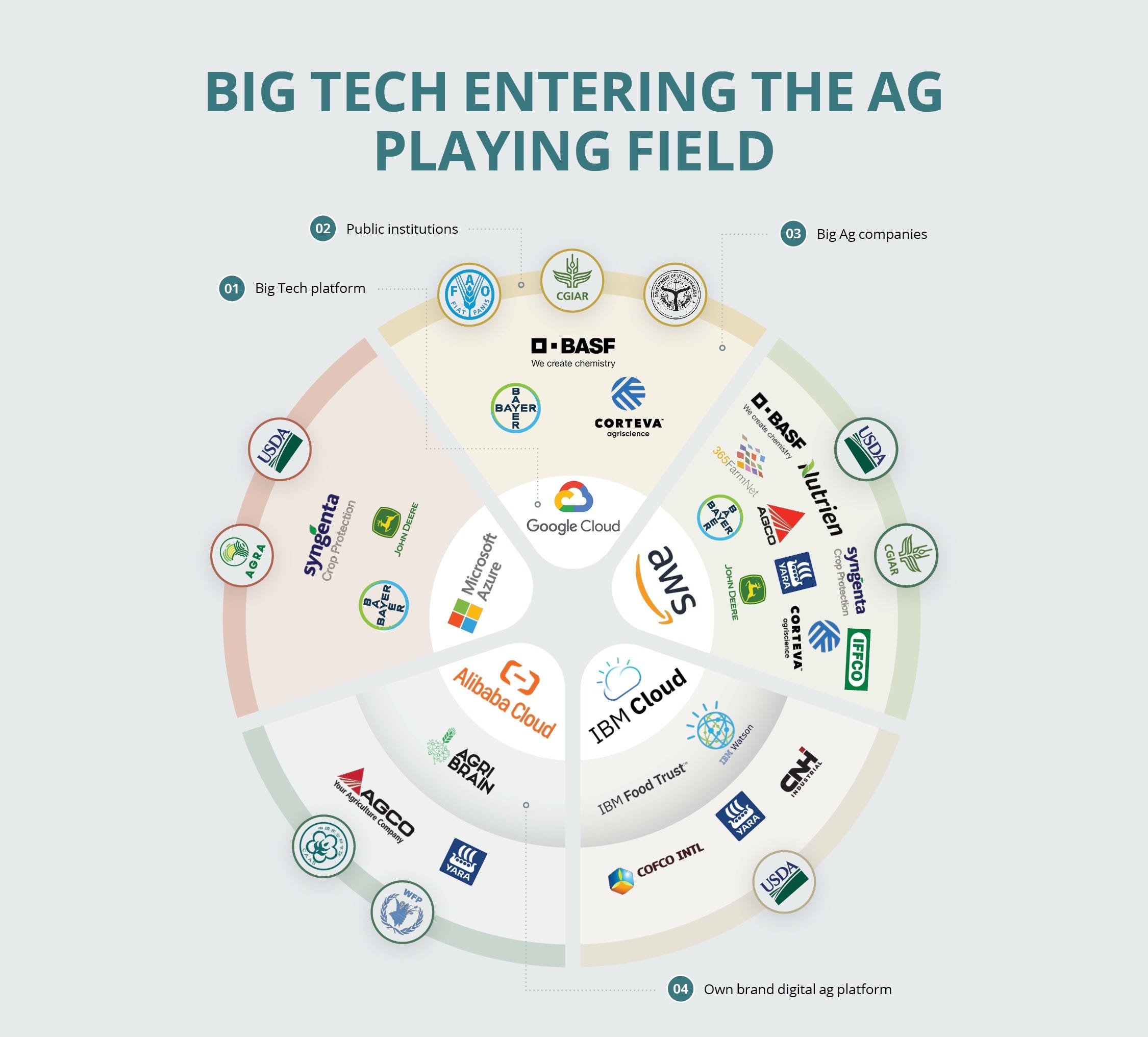
Image credit: IPES-Food
The risks of farming by algorithm
Consider a farmer in Ethiopia. A digital agriculture tool trained on global datasets may have little or no knowledge of teff, Ethiopia’s most widely consumed grain. Instead, it might recommend crops such as corn, for which extensive global data and agronomic models already exist, often linked to fertilisers and pesticides. In practice, such tools are likely to guide farmers toward crops and practices that reflect global datasets and supply chains rather than local agricultural realities.
This emerging model of “farming by algorithm” risks overlooking local knowledge, crops, and community-based innovation systems. There is a long-standing lesson in digital agriculture: good solutions must build on local knowledge and farming practices, not replace them.
As AI-driven agriculture expands globally through private-sector platforms and Big Tech–Big Ag alliances, questions arise about how these models will shape farming systems, particularly in low-resource LMIC contexts.
Models trained on global datasets can easily embed bias, and the risk of failing to support locally appropriate farming decisions is significant. At the same time, innovations rooted in local knowledge systems often remain undervalued and underfunded compared with large-scale, globally designed technology solutions.
Building the local data railways for grounded digital agriculture
In this context, the public sector is stepping in to lay the railways of localised and shareable data. The idea is to create national layers of publicly available agricultural data (covering soils, crops, weather and farming systems) that can serve as a shared foundation for AI models powering digital agriculture tools, from startups to research institutions.
Digital public infrastructure (DPI) for agriculture has emerged with the promise of building tools grounded in local realities. Agricultural DPI initiatives are now appearing across multiple countries, with very advanced examples in India, but also in places like Ethiopia, and more emerging initiatives elsewhere such as Côte d’Ivoire.
DPI is not just a technical architecture, it is also a governance tool intended to ensure that the intelligence layer of digital agriculture remains grounded in local ecosystems rather than dictated by global platforms, an approach that increasingly mirrors wider efforts by governments to build sovereign data infrastructures for AI.
The question is how these two major trends, global Big Tech–Big Ag coalitions and locally led agricultural DPIs designed to support innovation grounded in local data, will coexist.
Who controls the intelligence layer?
Global AI models, often trained on a relatively narrow set of crops and production systems, could increasingly shape farming decisions across very different contexts. Whether these systems will meaningfully engage with emerging public agricultural data infrastructures, and under what incentives, remains uncertain.
The IPES-Food report takes a strong stance on the role of Big Tech and large agribusiness firms. Ultimately, however, the debate it raises is less about technology than about power: who controls the intelligence layer of digital agriculture.
Agricultural DPIs may offer countries a pathway to anchor agricultural intelligence in more open and locally grounded data ecosystems. But the existence of a DPI alone does not guarantee that global technology or agribusiness firms will align with these frameworks. Even when they do engage, their scale and resources may give them disproportionate influence over how these systems evolve.
At the same time, most countries are still at a very early stage in building agricultural DPIs. Progress is emerging, but this knowledge infrastructure will take time to reach meaningful scale.
The key question for the coming decade is therefore not simply who builds the most advanced digital tools for farmers. Innovation will come from many directions: Big Techs, agribusinesses and local agritech startups alike.
The deeper question is who governs the intelligence layer on which these tools depend. In other words, who sets the rules, standards and data infrastructures that shape how agricultural knowledge is generated and applied.
In the end, the future of digital agriculture may depend less on who builds the algorithms, and more on who governs the systems that feed them.
This is a brilliant piece. Sadly, the LMICs that stand to be most negatively affected by the centralized intelligence layer of digital agriculture are, at best, asleep at the wheel, seemingly unaware of the wide-ranging implications of poor public investment in this space. The issue isn’t innovation capability; it’s data governance, control, and how agricultural data is interpreted to inform farm-level decisions.