

22/08/24
Hello Tractor shares details of government partnerships in Nigeria
In a LinkedIn article, Nigerian agritech Hello Tractor has shared details of its recent partnerships with the Ministries of Agriculture and Rural Development in Ekiti and Oyo States in the Southwest of the country. The partnerships, which were announced last March, aim to bring mechanisation and agri extension services. In both states, the agritech developed a database of farmers enabling community-based agents to schedule farming services such as ploughing, harrowing, and planting. The agritech also trained extension workers at the Ministry of Agriculture on how to register farmers. The agritech has equipped partner tractors with IoT devices for ministry-approved mechanisation services. Hello Tractor has developed a web application that allows the Ministry to have real-time visibility into registered booking agents, operators, and all tractor fleets involved in the project. In Ekiti State, the agritech has also started a pilot by deploying three of our Pay-As-You-Go (PAYG) tractors .
22/08/24
New challenge seeks climatech/agritech innovators in Vietnam, Cambodia, and the Philippines
Vietnam’s Food Innovation Hub (FIHV), a platform to mobilise innovators, scientists, and international experts in agriculture and food security, has announced the Grow Asia Innovation Challenge, an initiative that aims to support digitally-enabled, ready-to-scale, climate-smart solutions for smallholder farmers. The challenge will support marketability for low-emissions agri-products like rice and aims to establish a carbon marketplace to incentivise participation in carbon credit programmes for sustainable agriculture in the region. It targets smallholder farmers in Vietnam, Cambodia, and the Philippines.
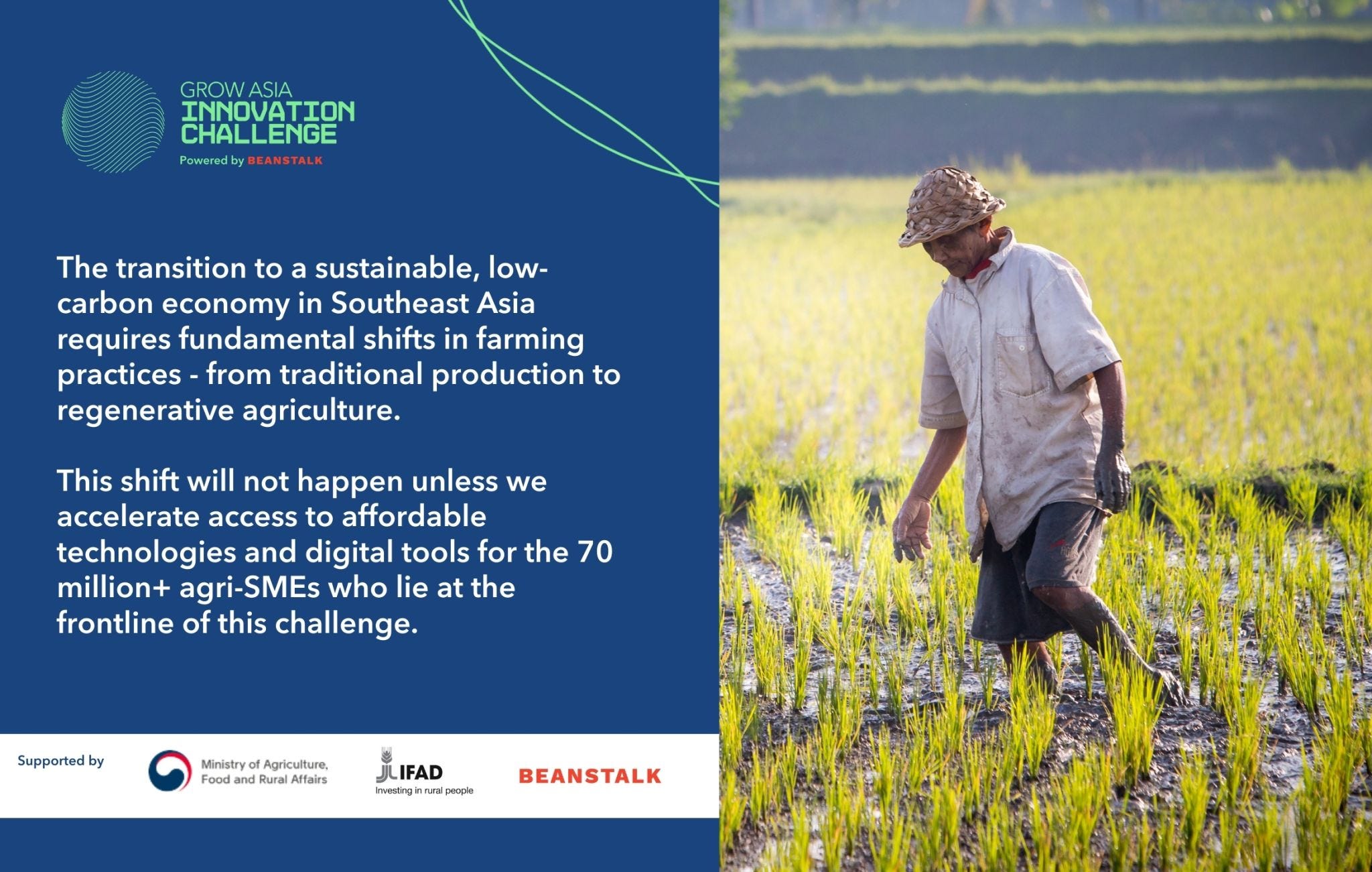
Source: Grow Asia
The initiative is supported by Grow Asia and Beanstalk AgTech, with support from the International Fund for Agricultural Development (IFAD) and Korea's Ministry of Food, Agriculture, and Rural Affairs (MAFRA). Innovators worldwide with a strategic interest in driving climate resilience in Southeast Asia are encouraged to apply.
28/08/24
Mastercard and Gramophone partner for farmer financing in India
Mastercard has partnered with Indian agritech Gramophone to provide agri inputs to two million smallholder farmers in India via the Mastercard Community Pass platform. The collaboration will facilitate offline payments for farmers in rural and remote areas using the Community Pass financial inclusion card. First piloted in Kenya in 2015, Community Pass is a digital platform that supports financial inclusion by enabling transactions for farmers. Actors engaged in agricultural value chain use the platform to source produce, while farmers can access markets and financing. Gramophone said that it is likely to leverage this partnership to also offer offline payments and credit to its existing 500,000 farmers. In addition, the agritech plans to introduce loyalty/cash-back systems for its subscribers with the offline-enabled card. Founded in 2016 as an agri advisory service, Gramophone has over time become a one-stop-shop also offering weather information and input linkages. The company has been developing a risk assessment tool leveraging its farmer and farm data. To date, the agritech has raised USD 17.9 million.
29/08/24
Indian agritech AgroStar publishes latest impact data
Indian agritech AgroStar has published its sustainability report for 2024 with the latest impact data. Established in 2013, AgroStar started as an e-commerce platform for inputs, and evolved to become a cloud platform combining agronomy and data science to provide customised crop advisory. Today, the company combines farm advisory with the provision of agri inputs. The agritech states that it has a network of 9+ million farmers in eleven Indian states. According to the sustainability report, 80 percent of AgroStar farmers have less than 2.5 acres of landholding. AgroStar states that farmers have increased their yield by an average of 27 percent with the help of its products and advisory services while reducing their input cost by 17 percent. The report also looks at the impact on other actors involved in last mile digitalisation. It states that last mile delivery partners are experiencing a 19 percent increase in income, while retail partners (input providers) see a 50 percent increase in margins associated with AgroStar. The full report can be downloaded here.
29/08/24
In depth: Starlink’s price war on rural connectivity causes tensions in Kenya
Satellite Internet provider Starlink, a company owned by American billionaire Elon Mask, has launched new low-cost plans allowing Kenyans without a StarLink kit to rent the hardware for as little as KSH 1,950 per month (USD 15). Buying a kit currently costs KES 45,500 (USD 350). Users will still have to pay for monthly plans, which currently start for as little as KES 1,300 (USD 10) for a 50GB plan offering speeds of up to 200 Mbit/s. The move to slash prices for the hardware has encountered the opposition of local telecom giant Safaricom, which is urging the Communications Authority of Kenya (CA) to bar the company from operating in the country.

Source: Starlink Kenya
In a formal letter to the CA, Safaricom highlights the lack of regulation for satellite providers, and “the potential to illegally provide services and cause harmful interference within the territorial borders”. In addition, the company points at the fact that satellite providers operate without paying into the country’s Universal Service Fund, which is meant to support rural network expansion. In summary, Safaricom calls for a level playing field with satellite players, which do not rely on “on-the-ground infrastructure” and are able to provide services directly to customers. Safaricom states that satellite service providers should only be permitted to operate in the country via partnerships with local licensees already present in the market.
Starlink has grown rapidly in Kenya since it entered the market just over a year ago (July 2023). Its satellite operator competitors are companies such as Skynet and NTvsat. However, in a competitive move, Safaricom also started offering 5G routers to appeal to customers outside its fiber network coverage. According to its quarterly report, Safaricom had 522,000 fixed data subscriptions at the end of March 2024. Interestingly, one of the reasons for rapid growth of Starlink is the integration of mobile money payments through Safaricom’s M-PESA. Starlink is already operating and licensed in several African countries including Benin, Nigeria, Rwanda, Malawi, Mozambique as well as Zambia.