

05/12/23
India’s StarAgri targets international expansion into Africa
India’s StarAgri Group is reportedly looking to expand internationally into the Middle East and Africa (Tanzania, Uganda, and Nigeria). The company said that it is targeting to eventually generate one third of its revenues from international markets. Founded in 2016, StarAgri is an independent entity backed by investors Temasek and Investcorp. As of 2023, it has a presence in 16 Indian states where it works with 100+ Farmer Producer Organisations (FPOs) to digitise the agricultural value chain under a B2B2C model. It claims to reach 100,000 farmers. StarAgri started as a provider of agri-warehousing services. Over time it has added a number of digital agriculture solutions to its portfolio. An example is Agribazaar, an app-based market linkage platform, which includes IoT farm management and agri fintech services.
06/12/23
Rural fintech Navadhan raises $5M for smallholder finance in India
Indian rural fintech Navadhan has raised USD 5 million in a Pre-Series A round led by Prime Venture Partners. Existing investors Varanium NexGen Fintech Fund and Gemba Capital also participated in the round. The startup will use the funds to scale up its digital technology platform dubbed AceN and to expand the distribution network and service delivery model. Established in 2019, Navadhan has a Non-Banking Financial Company (NFBC) licence. It has an end-to-end proprietary solution that supports on-sourcing, digital enrolments, credit underwriting, servicing, payments and collections for rural customers lacking income proofs and documentation. Its alternative underwriting model assesses the digital footprint of smallholder farmers and small rural businesses enabling them to access financial services. The startup has partnerships through API integrations with twenty between banks and NFBCs on its platform. Navadhan has to date raised USD 8 million.
09/12/23
Rwanda launches $2M agritech fund, agri-climate tech Loopa wins Hanga Pitchfest
The Government of Rwanda has announced a new USD 2 million fund that will provide financial and technical assistance to local agritech startups. The Hanga Agritech Innovation Challenge Fund was announced by the permanent secretary of the Ministry of ICT and Innovation Yves Iradukunda at the recent Hanga Pitchfest 2023, the largest in-person technology event in the country. It is supported by the Ministry of Agriculture and Animal Resources (MINAGRI) and the World Bank. Meanwhile, at the event, climate/agritech startup Loopa was awarded by President Paul Kagame the USD 39,700 prize as the overall winner of the Hanga Pitchfest 2023. Loopa utilises the Internet of Things (IoT) to optimise the conversion of food waste and other agricultural byproducts into nutrient-rich organic fertiliser, to assist farmers in transitioning from inorganic to organic fertiliser affordably while achieving higher yields.
10/12/23
Commonwealth Secretariat and AGRA partner for DPIs in African agriculture
During COP 28, The Commonwealth Secretariat and AGRA signed a memorandum of understanding (MoU) to support the development of agri-related digital public infrastructure (DPI) in Africa. Under the partnership, the Commonwealth will help facilitate multi-stakeholder dialogues on National Agricultural Data Infrastructure (NAgDI) and capacity building on national digital agriculture strategies in selected countries, as part of a suite of strategic initiatives. The NAgDI is a model of DPI being designed to support member countries to better manage their agricultural data. A DPI can be defined as a set of shared digital systems that should be secure and interoperable, and can be built on open standards and specifications to deliver and provide equitable access to public and/or private services. Examples in the agriculture sector are the G20’s proposed Digital Public Infrastructure for Agriculture in the Global South (DPI4A) and Ethiopia's data exchange DPI FarmStack.
11/12/23
MTN Ghana strikes digital ag partnership with GrowForMe
Mobile operator MTN Ghana has partnered with local agritech company GrowForMe to enable farmers to access markets, funders and climate-resilient solutions and training through its USSD menu. By contacting *170#, MTN’s customers will be able to finance farmers for inputs and commodity aggregation under a crowdfunding model, with a view to obtain a share of the profit at harvest or sales. Through the service, users receive monthly updates on the performance of farms or trades on the market. Crop buyers such as processing companies, exporters and market retailers are able to access commodities. Farmers and intermediaries sell their commodities at the nearest warehouse for instant payment on mobile money. Farmers can also request inputs, training, extension services, or mechanisation services from their phones. Founded in 2020, GrowForMe is a commodity and input financing, aggregation, and trading platform. According to its website, the startup has to date supported 518,000+ farmers with contributions from 554,000+ crowd funders across ten funder countries.
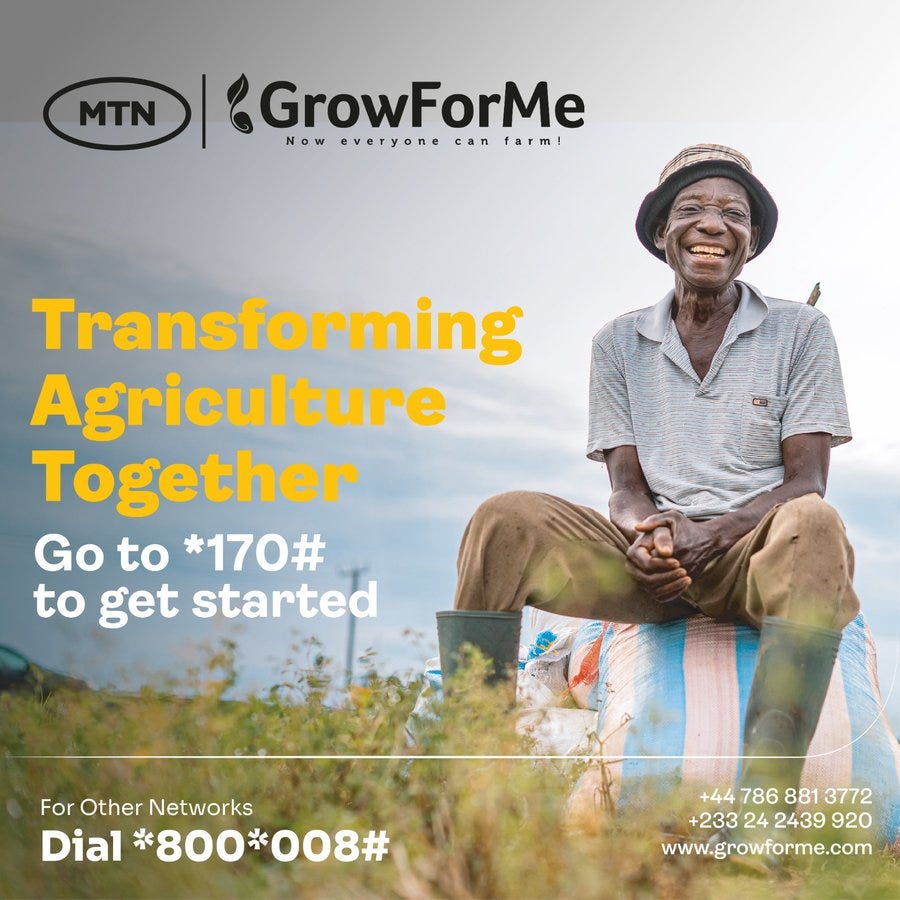
Photo credit: MTN Ghana, GrowForMe
Reflection point: Indian Agritechs venture into African markets with B2B2C/FPO model
This is the third time this year that an Indian agritech company announces plans to expand into Africa. In February, B2B agri e-commerce platform WayCool announced plans to enter the Kenyan market through its arm CensaNext Systems. More recently, in November, another B2B market linkage platform, Arya.ag, entered into an partnership to provide digital agriculture services to Kenyan agribusiness Fairgro Africa Limited (FGAL) in its home market as well as in Uganda, Tanzania, and Rwanda. As in the case of StarAgri, both WayCool and Arya.ag operate on a B2B2C model targeting India’s Farmer Producer Organisations (FPOs). These moves are signs of confidence by Indian agritechs on the viability of exporting their B2B2C model into African markets.