

07/11/24
iFarmer, VISA and UCB bank join forces for digital financial inclusion in Bangladesh
Bangladesh-based agritech startup iFarmer has partnered with VISA and United Commercial Bank (UCB) to support farmer financial inclusion. The new iFarmer Visa Card enables farmers to conduct cashless transactions for agricultural inputs, machinery, and other farming needs. Farmers can also use the card for ATM withdrawals and purchases at iFarmer centers. By introducing POS machines to rural retailers, the initiative extends digital payment capabilities to remote agricultural markets. VISA, iFarmer and UCB aim to generate digital transaction records and streamline farmer access to loans and credit.

Photo credit: Dhaka Tribune
Established in 2019, iFarmer is a full-stack agriculture startup enabling smallholders to access agricultural inputs, financing, advisory services, and markets. As reported by ArisTechia, just last September, the agritech received an investment from UK-based VC firm Razor Capital, though the financial terms were not disclosed. With the new funding, the startup is looking to expand its footprint, enhance its supply chain, and explore export opportunities.
11/11/24
Acumen announces $300M commitment for agri-climate adaptation
Non-profit impact investor Acumen has announced a USD 300 million climate finance commitment over the next five years to support agricultural adaptation founders, entrepreneurs, and social enterprises across East and West Africa, India, Latin America, and Pakistan. The investor is looking to provide funding and technical assistance to about 100 organisations. These will include providers of innovative climate solutions that create new markets (e.g. regenerative agriculture and carbon markets), and organisations that develop innovations for the productive use of energy in agriculture (e.g. solar-powered irrigation systems and storage solutions).
Acumen’s previous adaptation investments have been supported by the Green Climate Fund, the IKEA Foundation, and the UK’s Foreign, Commonwealth & Development Office (FCDO). By 2030, Acumen aims to help 40 million farmers increase their incomes and yields, creating a resilient food system.
11/11/24
New impact assessment on Indonesian agri e-commerce Semaai
A new impact assessment has been released about Indonesia’s agritech Semaai. The study looks at the startup’s advisory feature, Semaai Klinik, and supply chain financing solution. Semaai is an agri-e-commerce startup that provides inputs (seeds, fertilisers and pesticides) to agri retailers (toko tanis),in combination with advisory services. The company leverages a network of its own network of delivery centres to support service delivery.
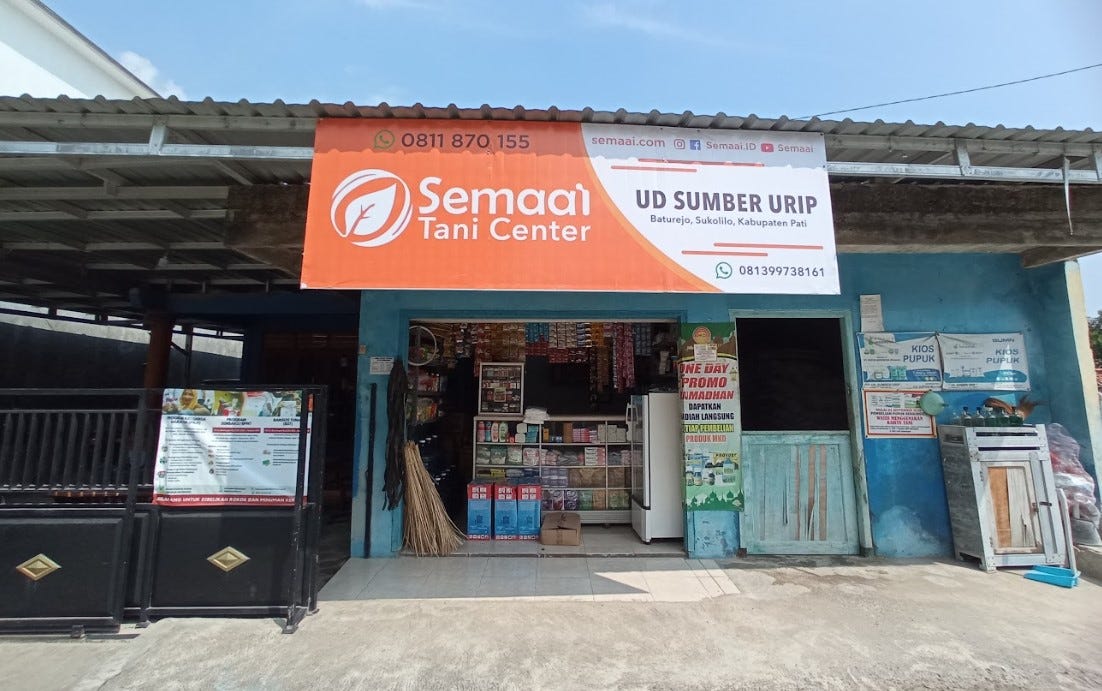
Photo credit: AsiaTechDaily
The study conducted by PRISMA - Australia-Indonesia Partnership surveyed 392 out of 4,470 agri kiosks using Semaai’s platform. It finds that 94% of kiosks reported increased knowledge, and 76% felt more confident in addressing farmer inquiries related to Good Agricultural Practices (GAP). As for farmer impact, the study outlines that 8,900 farmers became better informed about GAP practices, contributing to increased customer loyalty towards the kiosks. The study also finds a positive corelation between the use by kiosks of buy-now-pay-later (BNPL) schemes and their ability to offer loans to farmers. About 18% of kiosks currently give loans to farmers.
In January 2024, Semaai raised USD 4.7 million in a pre-series A funding round. Since it started in 2021, the startup has raised a total amount of USD 7.7 million. PRISMA is The Australia-Indonesia Partnership for Promoting Rural Incomes through Support for Markets in Agriculture. It partners with business and government to introduce products, services, and technologies that improve productivity and grow agricultural markets.
12/11/24
Analysis: A look at AgBase’s new report on agritech investment in Africa
AgBase, a knowledge platform on digital agriculture in the Global South, has launched The State of AgTech Investment in Africa 2024 report. The study finds that in the twelve months ending in September 2024, a total of 131 agritech companies raised USD 215 million in investment. This represents a small decrease from the previous twelve-month period, which saw the total amount of agritech funding in the region to reach USD 221 million.
The number of deals, however, increased to 158 in the year, from 147 deals recorded in the prior twelve months. The report also finds that agritech represents 11% of total funding volume and 23% of the number of deals raised across the overall African startup ecosystem across sectors. The greater number of deals shows the growing relative importance of the agritech sector within the digital and innovation landscape in the region.
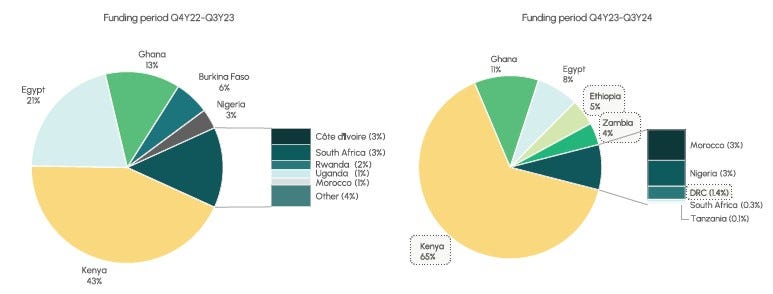
In the year, Kenya, the region’s main tech innovation hub, represented 65% of the total agritech funding volume in Africa. This compares to 43% in the previous 12 months. Other major agritech markets such as Egypt, Ghana and Nigeria all saw a decline in their share of funding volume. Newcomers included Ethiopia, Zambia and the Democratic Republic of the Congo, which accounted for nearly 10% of agritech funding volume.
Share of funding volume by market in the last two years
Source: AgBase
Another interesting funding from the study is about AI. Over the last twelve months, African agritechs using AI only raised USD 378,000, which is less than 1% of the total funding. However, there was significant activity, with AI-related deals representing 15% of total deals (up from 9% in the previous 12 months). This reflects the nascent nature of the AI ecosystem in the region. Some of the most funded solutions using AI during this period were precision agriculture, soil testing and robotics.
AgBase is an initiative of Briter Bridges backed by the Bill and Melinda Gates Foundation and The Foreign, Commonwealth & Development Office (FCDO), and implemented in partnership with Mercy Corps AgriFin. AgBase defines agritech broadly to include foodtech use cases (e.g. food delivery platforms) together with on-farm and post-farm use cases.