

24/01/24
ThriveAgric kicks off input distribution activities in Northern Nigeria
Nigerian agritech ThriveAgric has officially kickstarted its activities for the second farming cycle in Northern Nigeria targeting 100,000 smallholder farmers with agricultural inputs, including irrigation facilities, drought-resistant input and storage. The agritech officially announced commencement of activities for the new farming season at an event in Jigawa state, which brought together representatives from financial institutions, government and farming communities from Jigawa, Bauchi, and Kano. Founded in 2017, ThriveAgric has an end-to-end solution that digitises the agricultural value chain, from input financing to data-driven agri advisory and market access. In parallel, the agritech is also facilitating account bank opening and distributing debit cards to farmers in the Norther States of Jigawa, Bauchi, and Kano, as well as Adamawa, Gombe, Yobe, Kaduna and Katsina. This is part of an initiative launched last October with NGO Heifer International to facilitate access to financial services to 125,000 smallholders in the region. ThriveAgric has to date raised USD 60 million in funding, the bulk being the 56.4million in debt funding raised in March 2022.
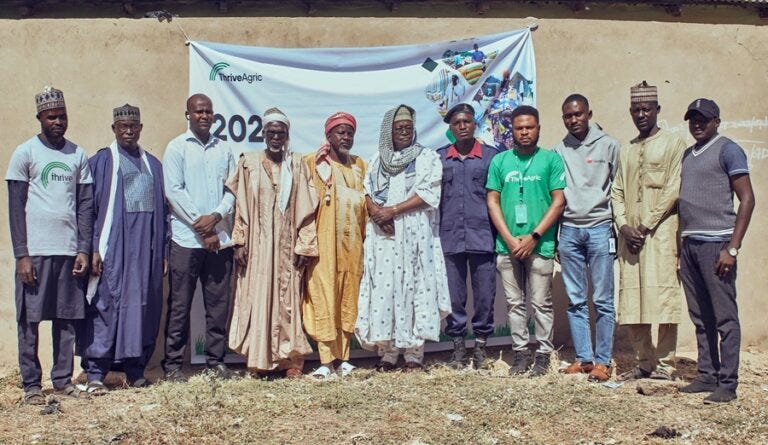
Photo credit: ThriveAgric, Disrupt Africa
25/01/23
Kenya-based Apollo Agriculture gets a further $10M loan to fuel expansion
Kenya-based agritech Apollo Agriculture has received a USD 10 million debt investment from Swedish development finance institution Swedfund and ImpactConnect, a programme implemented by DEG (German Investment Corporation). The loan will support expansion across Africa, after Apollo’s launch in Zambia in 2022. According to reports quoting Apollo’s CEO Eli Pollak, the agritech aims to serve 400,000 additional farmers during the loan’s term, accelerating its growth. Apollo states that it has to date reached 350,000+ smallholder farmers in Kenya and Zambia. Founded in 2016, its core offering is the product and financing platform for smallholder farmers, including quality agricultural inputs, insurance and optimised agricultural advice. The agritech uses machine learning and automated operations to serve farmers at scale. Apollo says that its solution supports crop yield increases by 2.5x times. In February last year, the company announced a USD 9.5 million loan from the US International Development Finance Corporation (DFC) to scale operations. It had previously raised USD 1 million in debt from the Agri-Business Capital Fund (ABC Fund), following its 2022 USD 40 million Series B funding round led by Softbank Vision Fund 2.
25/01/23
India’s Arya.ag partners with Ethiopia’s Lersha for digital farmer finance in East Africa
India’s Arya.ag, a B2B market linkage platform for the grain value chain, has signed a memorandum of understanding with Ethiopian agritech Lersha to partner on digital agriculture initiatives in East Africa. The partnership will initially target Ethiopia, Kenya, Uganda, Tanzania, and Rwanda. Established in 2013, Arya.ag provides market linkages and embeds in its platform financial services for smallholders owing less than five acres. The loans are provided against the stored commodity in the platform. In India, Arya.ag crossed INR 10 billion (USD 120 million) worth of loan disbursal in the financial year 22/23. As previously reported by AgrisTechia, Arya.ag is in the process of moving its loan operations onto the blockchain. At the core of the partnership is the ambition to facilitate the same type of blockchain-based, digitally-enabled commodity finance and market linkages model in East African markets. Founded in 2018, Lersha is a one -stop-shop enabling farmers to access inputs, hire mechanisation services, and request agro-climatic advisory via a mobile app and a call centre. The agritech deploys a network of 5,000+ agents. According to its website, it has to date reached 104,000 farmers.
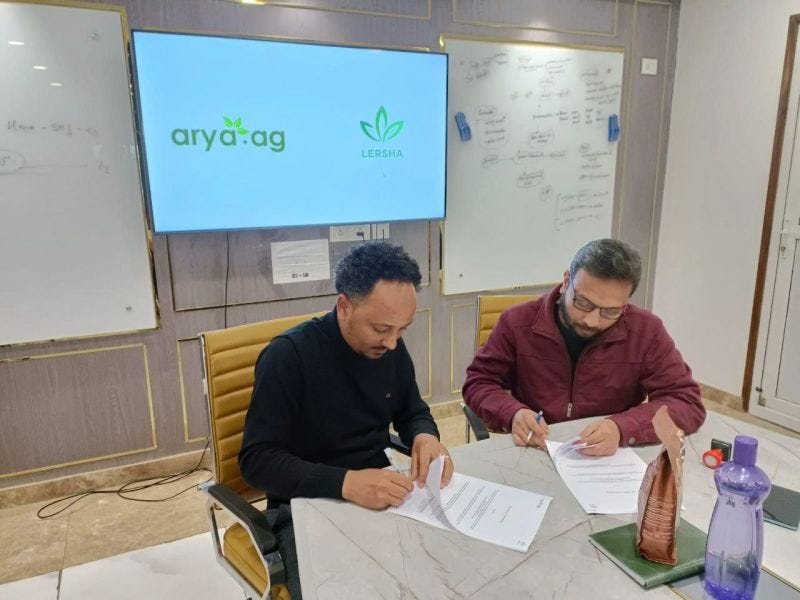
Photo credit: Lersha
26/01/24
InspiraFarms Cooling raises $1.09M for cold chain tech
Kenya-based InspiraFarms Cooling has raised EUR 1 million (USD 1.09 million) through a convertible note, from the Foundation for Clean Energy and Energy Inclusion for Africa (CEI Africa) alongside existing investors KawiSafi and Factor[e]. A convertible note is a debt instrument that allows the investor to eventually gain an equity investment at a later date. The funding comes after the startup raised its Series-B round in 2020 and signed an investment agreement with InfraCo Africa in 2023 to pilot its “cooling-as-a-service” model. Founded in 2012, InspiraFarms designs and installs precooling and cold chain technology for agribusinesses of all sizes in the fresh fruit and vegetables, flowers, and livestock value chains in Africa and other emerging markets. The solution is equipped with IoT sensors, and enables digital records and SMS communication. In Africa, only 5% of fresh produce enters the cold chain, compared to Europe’s 94%, and 30-50% of produced food is lost after harvest, which positions food loss as the second-largest emitter of GHG on the continent. InspiraFarms has to date raised a total of USD 6.1 million, according to Crunchbase.
29/01/24
Good reads: Study shows benefits of pest alerts to African farmers
A newly published study about the CABI-led Pest Risk Information Service (PRISE) project shows that smallholder farmers in four African countries (Kenya, Ghana, Zambia and Malawi) who received pest alerts based on earth observation data benefitted from reduced crop losses and higher incomes. PRISE, which began in 2017, uses data from a variety of sources such as satellite observations, weather data, geographic data, and details about the spread and biology of pests. These data were used to produce pest risk forecasts. One of the examples in the study shows that Kenyan farmers who received pest alerts for fall armyworm achieved an harvest of 2,089 kg/ha compared to 1,988 kg/ha for those who did not receive the alerts. CABI is an intergovernmental, not-for-profit organisation that applies scientific expertise to solve problems in agriculture and the environment. CABI has partnered for the PRISE project with agricultural agencies in the four countries including the Kenyan Agricultural and Livestock Research Organization (KALRO) and the Zambia Agricultural Research Institute (ZARI). According to CABI, the estimated economic impact of invasive alien pests alone on Africa’s agricultural sector was USD 65.58 billion a year (2021).