

02/04/26
India’s Aquapulse raises $2.8M to scale aquaculture services for smallholder shrimp farmers
India-based Aquapulse has raised INR 250 million (about USD 2.8 million) in a Series A round led by NABVENTURES, the venture growth equity fund of NABARD (India’s National Bank for Agriculture and Rural Development), through the AgriSURE Fund. The funding will support expansion of its integrated aquaculture ecosystem across eastern India, scaling its farmer network from more than 6,000 to 15,000 producers across Odisha, Andhra Pradesh and West Bengal, alongside investments in processing infrastructure and technology upgrades.

Image credit: Aquapulse
Aquapulse currently works with more than 6,000 shrimp farmers and plans to expand to 15,000 across eastern India. Its platform combines pond-level monitoring with grading, logistics and compliance systems, helping smallholder producers connect to export markets from which they are often structurally excluded.
Founded in 2022, the company provides water-quality monitoring, disease-risk alerts and feed optimisation tools at farm level while integrating post-harvest handling and traceability required for participation in export-oriented seafood supply chains.
Why it matters
The investment reflects growing interest in “pond-to-port” aquaculture models that connect smallholder producers with export markets and address fragmentation in India’s shrimp sector, where productivity, quality compliance and market access remain uneven.
10/04/26
Wadhwani AI pilots AgriVaani multilingual advisory chatbot for farmers and extension workers
Indian nonprofit Wadhwani AI has started piloting a multilingual conversational chatbot, AgriVaani, designed to support both farmers and extension workers with locally grounded agricultural advice delivered via voice-enabled interfaces.
The pilot is currently underway in Indore and Lucknow using a train-the-trainer deployment model, in which partner organisations prepare field facilitators before rolling out the tool to farmers.

Photo credit: Wadhwani AI
AgriVaani provides voice-enabled, multilingual recommendations built on Indian datasets and expert knowledge systems. This reflects a broader shift in agricultural AI development away from generic chatbot architectures toward locally trained advisory systems aligned with national data ecosystems and crop-specific decision contexts.
The pilot builds on Wadhwani AI’s earlier agriculture portfolio, including pest and disease detection tools such as CropAce and advisory support systems like Krishi Saathi, which has already resolved more than 279,000 farmer queries through call-centre integration across multiple states. Across its agriculture solutions, the organisation reports reaching over one million farmers through AI-enabled advisory tools.
In 2023, Wadhwani AI received a USD 3.3 million grant from Google.org, the Big Tech’s philanthropic arm. The funding is part of a USD 25 million open call that Google.org launched for organisations using AI to accelerate progress on the SDGs.
Why it matters
Locally trained AI systems aligned with national data ecosystems offer a major opportunity to augment extension workers (rather than replacing them) and can strengthen farmer support at scale.
10/04/26
Tanzania’s Kilimo Fresh joins Madica pre-seed cohort with up to $200K investment
Tanzania-based agritech startup Kilimo Freshhas secured up to USD 200,000 in pre-seed funding from Madica, an investment programme backed by early-stage investor Flourish Ventures, alongside participation in an 18-month founder support programme.
Kilimo Fresh aggregates fresh produce from smallholder farmers and supplies urban buyers through a technology-enabled distribution network that includes cleaning, sorting, packaging and delivery services. Kilimo Fresh plans to use the investment and support to enhance its software and AI-enabled systems that improve coordination and efficiency across fresh-produce value chains.

Photo credit: Kilimo Fresh
Founded in 2018, the company works to improve farmer market access while reducing post-harvest losses across fragmented horticulture value chains. The agritech claims to offer farmers prices that are 20% higher than those offered by middlemen.
The investment forms part of a USD 600,000 deployment across three African startups, with Kilimo Fresh selected alongside Kenya’s legaltech Hakimu and Nigeria’s health tech Biovana. Each company receives capital plus mentorship, executive coaching and exposure to Madica’s global investor network.
13/04/26
Ghana pilots parametric crop insurance under HAPPY programme with ignitia and WRMS Global
A parametric crop insurance pilot has been launched in Northern Ghana under the Harnessing Agricultural Productivity and Prosperity for Youth Programme (HAPPY) initiative, with non-profit TechnoServe working alongside weather forecasting company Ignitia and WRMS Global.
The pilot introduces index-based insurance designed to trigger payouts automatically when rainfall conditions fall outside predefined thresholds, reducing assessment delays common in conventional crop insurance schemes. Importantly, the inclusion of parametric insurance makes climate-risk protection integral to wider extension and value-chain support rather than a standalone service.
The initiative sits within the broader HAPPY programme, a four-year USD 61 million effort supported by Mastercard Foundation and implemented by partners including TechnoServe and Agri-Impact Limited to create 326,000 jobs for young people across poultry, rice, soybean and tomato value chains.
Why it matters
Parametric insurance rarely scales on its own. Evidence from Pula Advisors and OKO Finance shows uptake improves when bundled with inputs, advisory, or value-chain support. The HAPPY pilot follows this approach by embedding climate-risk protection within a broader agricultural programme.
13/04/26
SunCulture delivers parametric insurance payouts to PAYG irrigation farmers in Kenya
Kenya-based agritech SunCulture has completed the first payout cycle of its parametric climate insurance programme for farmers using its pay-as-you-go (PAYG) irrigation systems, marking an operational step in embedding climate risk protection directly into asset financing models.
Between October and December 2025, 1,738 farmers received automatic payouts totalling about USD 15,000 after drought conditions were confirmed using satellite data. Instead of requiring claims submissions, payouts were triggered automatically and applied to reduce farmers’ outstanding irrigation equipment loan balances, easing repayment pressure during the affected season.
Coverage expanded by 152% over the period, with drought triggers calibrated at constituency level to reflect local climate variability. The programme is implemented with Humanity Insured, APA Insurance and climate insurance specialist IBISA Network, with expansion to Uganda planned for 2026.
In September 2025, SunCulture received a USD 5 million investment from WaterEquity’s Water & Climate Resilience Fund, highlighting rising investor interest in irrigation as climate adaptation infrastructure.
The rollout highlights a broader shift from standalone parametric insurance products toward embedded climate-risk protection integrated into bundled irrigation, finance and advisory services for smallholder farmers.
Why it matters
Bundling parametric insurance with irrigation asset financing shows how climate-risk protection can support adoption of productive technologies while reducing repayment risk. This approach may offer a more scalable pathway than standalone crop insurance in smallholder farming systems.
02/04/26
Analysis: New report highlights widening gap between agritech potential and investment in South and Southeast Asia
A new report by consulting firm Beanstalk AgTech and market intelligence company Briter, supported by Rabo Foundation, International Finance Corporation, FMO and Omnivore, highlights a widening gap between agritech’s economic potential and current investment momentum across thirteen countries in South and Southeast Asia (excluding India).
While agritech adoption could generate more than USD 90 billion in additional annual GDP by 2033, investment across the region fell by nearly 70% between 2022 and 2025, reflecting investor uncertainty about which business models can scale sustainably despite continued demand for digital agriculture solutions.
The report finds that many early agritech ventures continue to face logistics complexity, thin margins and limited expansion opportunities across fragmented smallholder systems. It also identifies the main constraint at the Seed-to-Series A transition, where fewer companies progress to later funding rounds. Development finance institutions are therefore expected to remain central to early-stage market formation, with blended finance combining equity, credit and concessional capital continuing to underpin agritech investment.
The innovation gradient across regional ecosystems
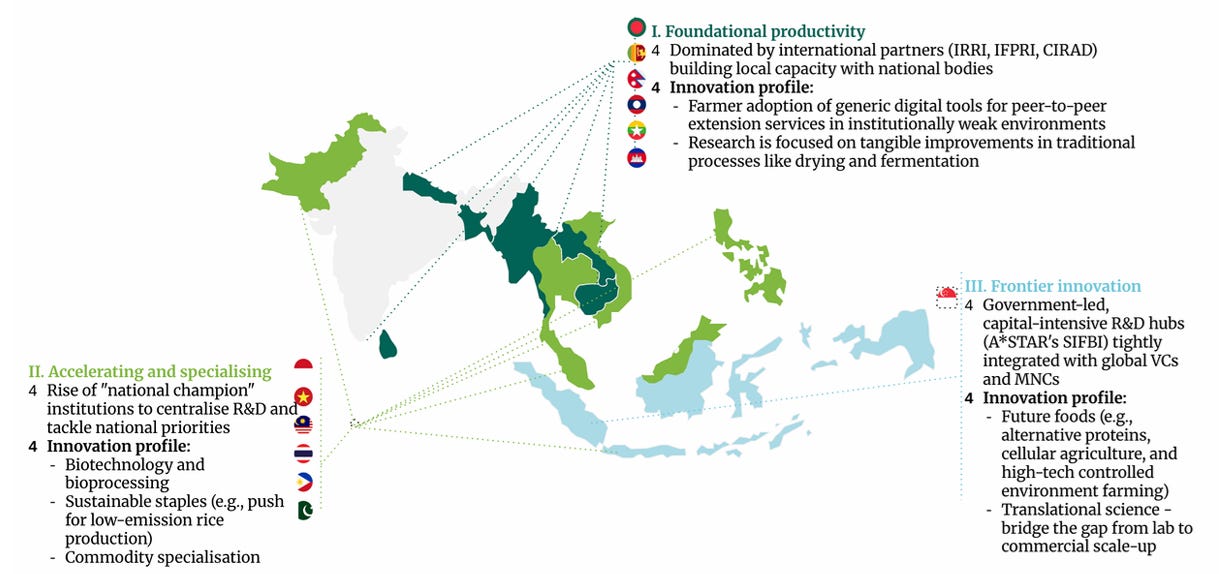
Source: Beanstalk AgTech, Briter
Another key finding concerns the difficulty of regional scale-up. While in Africa commonalities in language, donor ecosystems and agricultural market structures are enabling a growing number of agritechs to expand across borders, South and Southeast Asia remain highly fragmented. Differences in policy regimes, value-chain structures and farm organisation mean that approaches successful in markets such as Vietnam or Indonesia often require substantial redesign before entering neighbouring countries. Scaling depends primarily on a high degree of country-specific adaptation rather than regional rollout strategies.
In terms of emerging opportunity areas, the report finds that investment is increasingly concentrating on traceability-driven digital value chains, embedded agricultural finance linked to procurement systems, and aquaculture.