

11/06/26
Nigerian agritech Agriarche secures Proparco backing
Nigerian agritech Agriarche has secured investment from Proparco, the private-sector financing arm of the Agence Française de Développement (AFD), to expand its tech-enabled agricultural platform and strengthen value chains in northern Nigeria.
Agriarche operates Kasuwa, a market linkage platform connecting smallholder farmers, aggregators, food processors and FMCG companies. The platform combines market information, payments and financing with aggregation, storage and logistics to improve market access and supply chain efficiency.

Photo credit: Agriarche - Kasuwa platform on Google Play.
The investment builds on previous funding secured in February 2025, when Agriarche received a USD 500,000 working capital loan from Sahel Capital’s Social Enterprise Fund for Agriculture in Africa (SEFAA), s programme supported by German development bank KfW to expand connections between farmers and FMCG companies.
According to Proparco, Agriarche now operates across nine Nigerian states, serving more than 25,000 farmers through its digital platform and fulfilment centres. The company reports generating more than USD12 million in transactions, while 42% of participating farmers are women. Proparco says that partnerships with input providers have also helped farmers achieve an average 40% reduction in production costs.
Why it matters
Yet another proof point that investors – in this case development finance institutions – continue to see significant potential for scale and impact in well-executed market linkage platforms built on digital value-chain infrastructure. Agriarche is not as large or as well known as other market linkage platforms, but it offers a compelling value proposition for both farmers and value chain actors, from access to inputs all the way to selling outputs. An interesting reminder that being small and well executed can matter more than being big and visible but lacking substance.
05/11/26
Bangladesh’s iFarmer expands digital investment platform
Bangladesh agritech iFarmer has rebranded its agricultural funding platform from iFarmer Funding to iharvst, expanding its focus beyond crowdfunding to provide a broader range of investment opportunities across the agricultural value chain for agri-funders.
Launched in 2019, iFarmer is a full-stack agritech providing smallholders with access to agricultural inputs, financing, advisory services and markets through an integrated digital platform. The company also operates the Folon app, which provides personalised crop advice, connects farmers with agricultural experts, and gives access to loans.
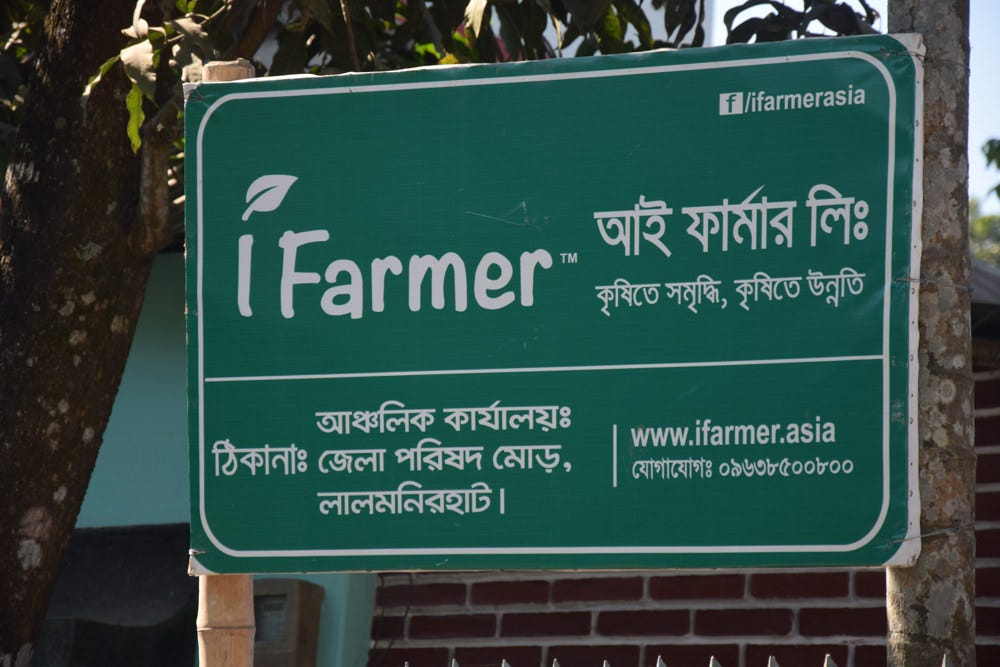
Photo credit: iFarmer
The rebranding of iharvst follows a period of continued growth for the company. According to the company, iharvst has facilitated more than USD 10 million in agricultural financing and supported investments across over 700 farming projects, enabling individuals and institutions to participate in agricultural production through a digital platform. The solution is designed to channel capital into farming while improving transparency and access to investment opportunities.
In April 2026, iFarmer secured USD 1.5 million from Switzerland-based impact investment platform Symbiotics to expand agricultural input distribution and strengthen market linkages. The company had previously raised investment from UK-based Razor Capital and built partnerships with multiple financial institutions to provide loans and insurance products for farmers.
Beyond financing, iFarmer has established a nationwide physical network of more than 1,200 iFarmer Centers, partnering with agri-input retailers and traders to provide digital onboarding, advisory services and market access to farmers. The company estimates that it has supported more than 100,000 farmers through its integrated platform.
Agriculture remains a cornerstone of Bangladesh’s economy, employing around 40% of the national labour force and supporting an estimated 20 million farmers, around 80% of whom are smallholders.
Why it matters
It’s great to see how agritech models continue evolving in Bangladesh, with a bunch of innovators active in the market and positioning themselves as digital infrastructure connecting farmers, retailers, financial institutions and investors across the agricultural value chain. Besides iFarmer, other interesting companies to watch are Agromukam, Agroshift, WeGro and Fashol.
11/06/26
Nigerian insurtech Riwe secures UNDP backing to scale digital climate insurance
Nigerian climatech/insurtech Riwe has secured funding and a strategic partnership from the United Nations Development Programme (UNDP), the Islamic Development Bank (IsDB) and the Islamic Solidarity Fund for Development (ISFD) to expand digital climate insurance for smallholder farmers.
Founded in 2022, Riwe (from riweaku which means “keep eating well”) develops parametric weather insurance products that leverage satellite earth observation data and automated smart contracts to trigger payouts when predefined climate conditions are met. The platform is distributed through a USSD interface accessible on basic mobile phones and a network of community agents embedded in farming communities.
Under its RAIN (Resilience through Affordable and Inclusive Weather Insurance) programme, the company will establish community experience centres and work with partners including Leadway Assurance and Novus Microfinance Bank to provide insurance enrolment, agricultural input loans and weather advisory services.
A key component of Riwe’s model is a digital identity layer designed for farmers with no formal financial history. By capturing farm-level data, climate exposure and insurance behaviour over time, the platform creates a digital profile that can support loan applications, insurance underwriting and product eligibility decisions, providing farmers with a data-backed entry point into the formal financial system.
Riwe currently serves more than 15,000 farmers and aims to reach 200,000 by 2030.
Why it matters
Digital agricultural insurance has long been one of agritech’s most challenging business models, constrained by high distribution costs and complex claims processes. However, the sector is gaining momentum as the combination of satellite data, AI intelligence and mobile channels make parametric insurance products easier to deliver and scale. Riwe’s funding adds to a growing body of evidence that digitally enabled agricultural insurance is attracting increasing institutional support in Africa, with larger players such as Pula and OKO leading the charge.
05/06/26
Kenya launches government-led AI platform for agriculture and food security
Kenya has officially launched ADAPT (AI-enabled Data for Agriculture Products & Transformation), a government-led initiative that brings together public institutions, research organisations, development partners and technology companies to apply AI, earth observation and advanced data analytics to agriculture and food security.
Led by the State Department of Agriculture under the Ministry of Agriculture and Livestock Development, ADAPT-Kenya is supported by the Gates Foundation and Microsoft AI for Good Lab and brings together an extensive ecosystem of partners, including FAO, UNDP, Kenya Space Agency, KALRO, Kenya Meteorological Department, NASA Harvest, FEWS NET, University of Maryland, Ai2, AGRA and One Acre Fund.
The platform will combine satellite imagery, AI models and national data systems to support crop monitoring, yield forecasting, insurance zone delineation, disaster risk reduction and climate resilience, providing data and analytics that can inform agricultural planning and decision-making across the country. ADAPT-Kenya is also intended as the first country-level implementation of a broader ADAPT-Africa model designed for replication across the continent.
The launch comes as the UK Foreign, Commonwealth & Development Office (FCDO) is supporting complementary research on AI for climate-smart agriculture and food security in Kenya, focusing on agricultural data gaps, governance models and the conditions required to scale AI-enabled services responsibly and inclusively.
Why it matters
An interesting aspect of ADAPT is that it shifts the focus from individual AI applications towards shared agricultural intelligence. Rather than creating another farmer-facing advisory tool, the initiative combines AI, earth observation and national data resources into a common analytics platform capable of supporting multiple services, from crop monitoring and yield forecasting to insurance planning and disaster response. If successful, this government-led, multi-stakeholder approach could provide a blueprint for how countries build AI capabilities for agriculture: not as standalone applications, but as shared intelligence layers that enable a broad ecosystem of public and private services.
05/06/26
Innovator to watch: Sandi AI launches precision irrigation service
One of the more interesting digital agriculture launches this month comes from Uganda, where Sandi AI, an early stage company, has launched Sandi Moisture Intelligence, combining low-cost soil sensors, AI-powered analytics and community financing to help smallholder farmers optimise irrigation.
The solution uses 2–6 soil moisture sensors, costing USD 10–20 each and often bundled with Sandi-financed solar pumps or drip irrigation kits. The sensors collect real-time soil moisture data, which is combined with hyper-local weather forecasts, crop-specific water requirements, soil type, topography and evapotranspiration rates to generate irrigation recommendations.
Farmers receive guidance via WhatsApp (including voice notes), SMS or USSD, identifying which parts of their fields require watering immediately and which can wait. The system is designed to reduce pumping costs, prevent overwatering and nutrient leaching, and improve water-use efficiency, with calibration for local soil types in Uganda and Kenya.

Photo credit: Sandi AI
The service is offered free to members of Sandi AI’s rotational savings groups, who can access the sensors through community financing. According to its website Sandi AI has reached more than 10,000 active savings groups across Uganda and Kenya using a digitized chama model to help communities collectively save for solar systems, cookstoves, and water filters. It plans to expand into Tanzania. The company also provides aggregated water-efficiency reports that groups can use to strengthen applications for microfinance loans.
Why it matters
As climate variability increases, precision irrigation has remained out of reach for most smallholders because of hardware costs and complexity. Sandi AI’s model focuses on affordable sensors, embedded financing and simple digital interfaces to make data-driven irrigation accessible at community level. As usual with this kind of solutions, the challenge is scalability and maintenance of equipment but the focus on low-cost, easy-to-adopt services could significantly broaden adoption beyond commercial farms.
08/06/26
Analysis: India’s multilingual AI infrastructure is quietly transforming agricultural advisory
One of the most interesting articles I read this week (thanks to Vikram Kothari for sharing it on LinkedIn) wasn’t about a breakthrough AI model or another agritech funding round. Instead, it highlighted something less visible: the emergence of multilingual AI infrastructure as a foundational capability for digital agriculture.
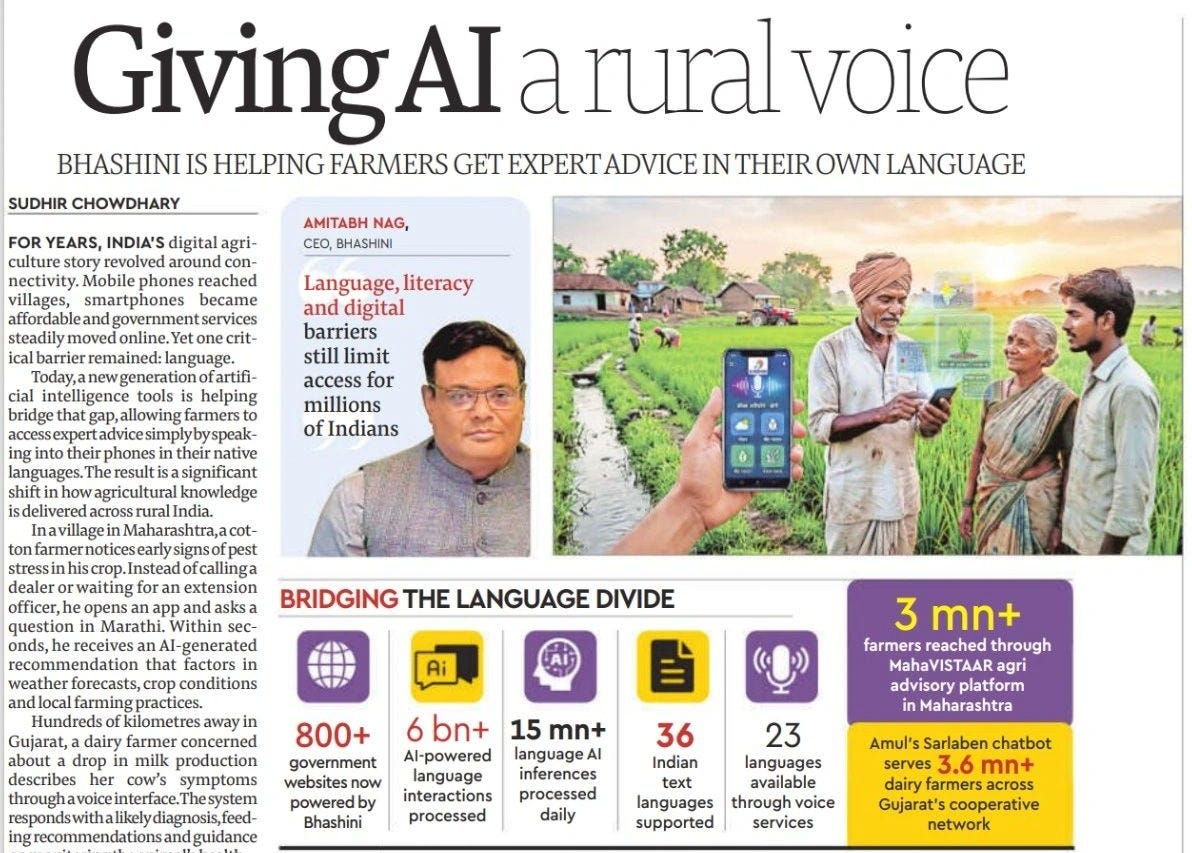
Source: Financial Express
At the centre of the story in the Financial Express newspaper is BHASHINI, a flagship initiative under India’s Digital India programme and National Language Translation Mission. Rather than building another farmer-facing application, BHASHINI provides a shared language layer that enables voice and text interactions across 23 Indian languages, supports 36 text languages, powers more than 800 government websites, and processes over 6 billion AI-powered language interactions and 15 million AI inferences every day.
The platform is already being embedded into agriculture at scale. Maharashtra’s MahaVISTAAR, a multilingual educational and advisory platform for farmers, combines crop guidance, weather intelligence, market prices and government schemes into a single AI-powered advisory service reaching more than 3 million farmers. In Gujarat, the Amul Sarlaben is a localised AI-powered dairy assistant offering personalised advice on animal health, nutrition, breeding and milk production to 3.6 million dairy farmers across 18,500 villages.
What caught my attention is that BHASHINI is not an agricultural platform. It is a shared capability that sector-specific services can plug into, allowing farmers to interact naturally in their own language rather than adapting to a new interface. The initiative can be described as attempting for language what Digital Public Infrastructure (DPI) has achieved for identity and payments: creating a common, reusable capability that supports an entire ecosystem instead of being rebuilt by every application.
Viewed alongside AgriStack, which provides digital farmer identities and agricultural data, and the Krishi Decision Support System, which delivers geospatial and agronomic intelligence, BHASHINI appears to add another layer to India’s evolving digital agriculture architecture.
Whether this approach ultimately translates into better outcomes for farmers remains, as always, to be seen. Adoption, governance, interoperability and institutional coordination will matter as much as the technology itself. But the idea of treating multilingual AI as shared infrastructure, rather than as a feature of individual applications, is an interesting one, and a model worth watching beyond India.