

08/05/25
Arya.ag posts strong financials, climate focus pays off
Indian agritech Arya.ag, the country’s largest B2B market linkage platform for the grain value chain, has recorded a 70% jump in net profit and a 27% increase in net revenue in the past year. This performance suggests that the business model has held up under commodity price fluctuations, the logistical difficulties of reaching farmers in rural India, and weather-related disruptions to agricultural production.
Through its market linkage platform, Arya.ag connects farmers and farmer producing organisations (FPOs) directly to buyers across India. In addition, the platform embeds financial services, such as farmer loans against their stored commodity in the platform. The company has been increasingly focusing on digitally-enabled climate smart innovations due to the growing challenge represented by climate change. Data from the Indian government show projected yield reductions of 20% for rain-fed rice and 19.3% for wheat by 2050 due to climate change.
Arya.ag was established in 2013. Just in January this year, the company secured USD 30 million debt financing from HSBC bank and GuarantCo, a financial institution under financial services company Private Infrastructure Development Group (PIDG).
10/05/25
Nigerian government endorses FAO’s Digital Villages
The Federal Government of Nigeria has endorsed the Digital Villages Initiative (DVI), which was recently launched in the country by The Food and Agriculture Organization of the United Nations (FAO). The initiative aims to boost sustainable agrifood productivity through the integration of digital technologies across agricultural systems. In Nigeria, the DVI will focus on digitalising agricultural value chains, strengthening research and innovation frameworks, and enhancing farmer extension services to improve knowledge dissemination and technical support at the grassroots level.
A key component of the initiative is the development of real-time agricultural data management systems, designed to support more effective planning, monitoring, and evidence-based policymaking. During a keynote address at the DVI inception workshop, Minister of Agriculture and Food Security, Abubakar Kyari, announced the creation of a national Digital Public Infrastructure (DPI) dubbed National Integrated Digital Agriculture Platform. This platform is expected to serve as a centralised hub for farmers, policymakers, and stakeholders to access essential data, services, and resources.
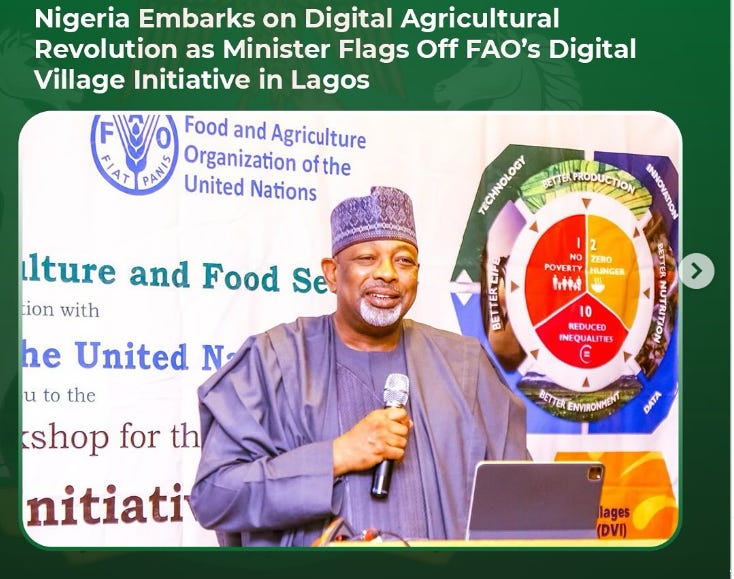
Photo credit: Office of the Honourable Minister of Agriculture and Food Security, Instagram
The initiative is aligned with Nigeria’s 10-year National Digital Agriculture Strategy (NDAS) and the broader National Digital Economy Policy and Strategy (NDEPS), signalling the country’s ambition to transform its agrifood systems through digital innovation.
14/05/25
Indian rural fintech Kaleidofin gets $5.3M from IDH Farmfit Fund
Indian fintech Kaleidofin has raised USD 5.3 million in equity from the IDH Farmfit Fund, a blended finance impact fund focused on smallholder value chains. This funding brings the current round’s equity infusion to USD 19 million. Kaleidofin had earlier announced an investment of USD 13.8 million led by Rabo Partnerships, a subsidiary of Rabobank dedicated to fostering financial inclusion, rural development, and sustainable food security in emerging markets.
Kaleidofin has built a digital ecosystem to accelerate access to formal finance for small and growing businesses in the informal sector. The main customers of the company are small and marginal farmers, women-led enterprises and nano enterprises.

Photo credit: The Startupstars
Alongside the funding announcement, Kaleidofin has revealed a new initiative in collaboration with IDH to develop a specialised version of its proprietary credit risk scoring system, known as the ki score. The company plans to develop a credit health assessment product designed to cater to the unique needs of the agricultural sector. The model combines demographic, geographical, credit history, savings, payments, and other alternate data, offering lending institutions a probability of default score for customers with or without credit history.
Established in 2017, Kaleidofin has to date raised an impressive USD 42 million. The IDH Farmfit Fund is the world’s biggest ever public-private impact fund for smallholder farmers.
In other news:
13/05/25
Heifer awards $40K to Nigerian agritechs, VetKonect gets second prize
NGO Heifer International has awarded USD40,000 in grants to three Nigerian agritech entrepreneurs startups through the 2024 AYuTe Africa Challenge Nigeria. This initiative aims to foster youth-led innovations that enhance smallholder farming and food security. One of the winners is Vet Konect, a digital animal health company that is leveraging technology to enable access to animal care and social protection for livestock farmers. The startup received USD 12,000 for developing a digital platform that provides AI-driven animal health services to livestock farmers. The top prize of USD 20,000 was awarded to Ruth Ede of Scratop Nigeria for her work in converting biowaste into nutrient-rich biofertilisers, promoting sustainable agriculture.
15/05/25
Good reads: Beyond data, WEF’s view on how to unlock agriculture’s potential
A new article by the World Economic Forum (WEF) highlights that while greater availability of digital data presents strong potential to improve agriculture and food systems globally, the true potential of this data remains untapped without coordinated integration into national systems. The article, titled Beyond Data: How to Unlock Agriculture’s Full Potential, explores how fragmented data ecosystems, and the existence of too many disconnected data siloes, continue to hinder the impact of agritech innovations, particularly in emerging economies.
The article takes the example of India to highlight the importance of centralised platforms such as AgriStack and Krishi DSS to consolidate agricultural data and enable real-time, location-specific advisories for farmers. AgriStack, for example is a Digital public Infrastructure (DPI) built on three foundational registries: geo-referenced village maps, crop sown registry and the farmers registry. Maintained by State Governments and Union Territories, these databases enhance farmer identification and streamline agricultural planning. Beside data sharing, WEF highlights that the key value-add of these platforms is privacy and trust among end-users.
The WEF also stresses that data alone isn’t enough. Unlocking the potential of digital agriculture requires collaborative governance, investments in rural connectivity, digital literacy, and interoperable platforms. The article argues that countries must move “beyond data” to create inclusive, farmer-centric and scalable digital agriculture ecosystems.