

17/02/26
India reveals rollout details for Bharat-VISTAAR AI advisory
New details have emerged on Bharat-VISTAAR, India’s multilingual AI agritech tool designed to unify advisory information across government data systems and deliver it through voice and digital channels. Announced in the 2026–27 Union Budget with an allocation of INR1.50 billion (approx. USD 16.5 million), the initiative will provide real-time weather, soil, pest and disease alerts, mandi (middleman) prices and scheme information via a toll-free helpline (155261), chatbot, mobile app and web interface.
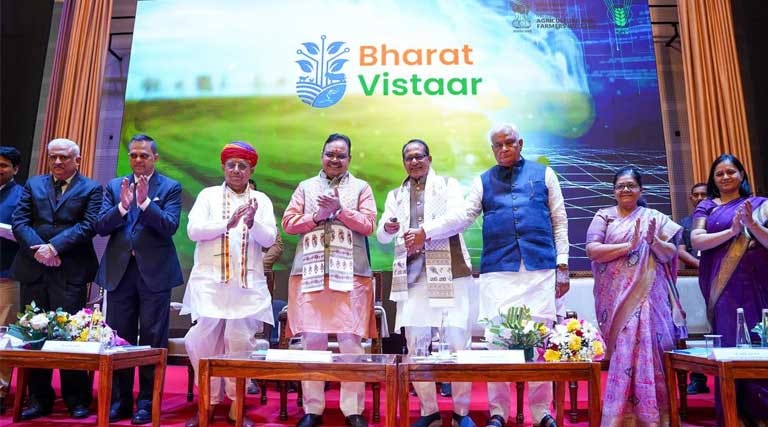
Photo credit: Global Agriculture
Bharat-VISTAAR integrates India’s AgriStack portals and the Indian Council of Agricultural Research’s recommended practice packages with AI systems to generate crop- and location-specific guidance in multiple languages. Initial rollout will support Hindi and English, with additional regional languages to follow, consolidating fragmented central and state datasets into a single AI-enabled interface.
Bharat-VISTAAR functions as an AI interaction layer within India’s agricultural Digital Public Infrastructure (DPI), sitting on top of existing farmer registries and AgriStack data systems rather than replacing them. At launch, it will surface information from major government schemes and datasets and contextualise it through AI-generated guidance, with deeper integrations expected as DPI components expand.
Why it matters
Bharat-VISTAAR marks a shift from building agricultural data registries to deploying a national AI interaction layer on top of them. The latest rollout details, including USD16.5 million in budget backing and a toll-free voice interface, indicate a clearer push toward last-mile accessibility for underserved and voice-first farmers at scale.
18/02/26
IFC partners with Coopbank to expand digital agri finance in Ethiopia
The International Finance Corporation (IFC) has partnered with the Cooperative Bank of Oromia (Coopbank) to expand access to finance for smallholder farmers, cooperatives, and agribusinesses in Ethiopia, leveraging digital technology to address gaps in agricultural lending.
Under the agreement, IFC will support Coopbank in strengthening its agribusiness services by improving credit risk management and using digital platforms to deliver tailored financial products across agricultural value chains. The initiative aims to link finance more closely to production cycles, inputs, and markets, reducing reliance on collateral-based lending models that have limited smallholder access.
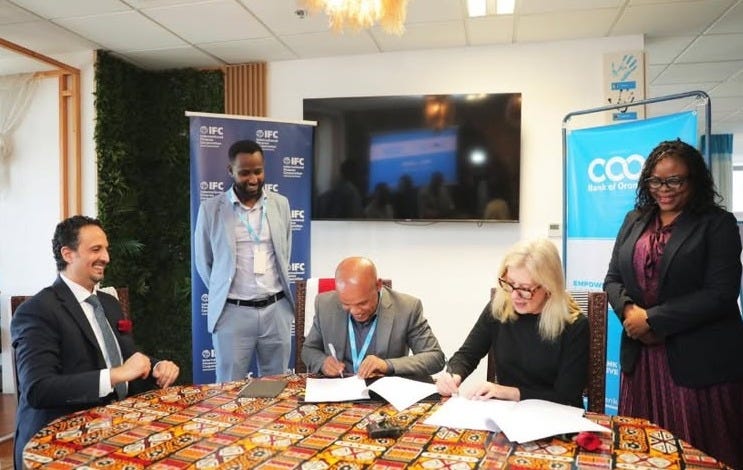
Photo credit: Cooperative Bank of Oromia
Coopbank, majority-owned by farmers and cooperatives, operates more than 750 branches nationwide, with 76 percent located in rural and semi-urban areas. Its digital platforms include the Michu Digital Lending app, an AI-driven loan service developed in partnership with local fintech Kifiya, and Farmpass, launched with Mastercard to digitise payments and farmer financial histories, strengthening market linkages and access to financial services. Together, these platforms have reportedly reached more than 2.7 million users, primarily youth and women, enabling access to markets and uncollateralized financing.
Why it matters
Ethiopia’s Digital Agriculture Roadmap (2025–2032) puts credit and insurance at the heart of its scale-up strategy. With Coopbank’s deep rural reach and IFC’s backing, this partnership could become one of the most tangible vehicles for turning those digital agri finance ambitions into real, on-the-ground delivery.
17/02/26
New AI initiative digitises African languages for farmer advisory
A new collaboration between International Food Policy Research Institute (IFPRI) and Farm Radio International (FRI), supported by CGIAR’s Accelerator on Digital Transformation, aims to use AI and natural language processing to strengthen agricultural extension systems.
The partners are developing Longa (“Let’s chat” in Swahili), an AI-powered speech recognition tool that automatically transcribes, translates and analyses farmers’ voice messages in local languages. FRI receives thousands of voice messages each week through its participatory radio programmes, but much of this feedback remains underused due to language and resource constraints.
Trained on languages including Luganda and Bambara, Longa is designed to outperform generic speech models in low-resource language settings. By converting voice messages into structured data, the tool aims to make agricultural advisory more responsive, evidence-based and inclusive.
Why it matters
Digitising underrepresented African languages is foundational to making AI work for African farmers. Initiatives like this help build language models grounded in local words, concepts and contexts, rather than adapting global tools that overlook them.
14/02/26
Kenya announces dairy value chain digitalisation plan, targeting 1.8M farmers
Kenya’s Kenya National Chamber of Commerce and Industry (KNCCI), in partnership with pan-African credit guarantor Africa Guarantee Fund and dairy-focused agritech Space AI, has launched a climate-smart dairy value chain transformation project aimed at strengthening the sector for 1.8 million smallholder farmers.
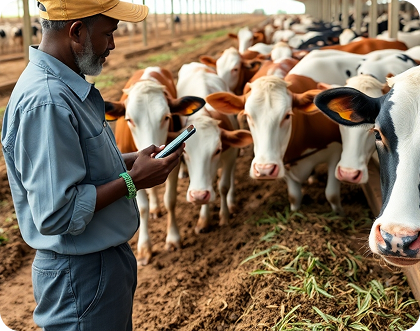
Photo credit: Space AI
The programme is rolling out digital systems with participating cooperatives in key dairy-producing counties. Space AI, which specialises in digitising dairy value chains, is implementing farmer profiling, milk data capture and automated check-off systems. These tools create structured production and payment records, giving cooperatives and partners clearer visibility across the value chain.
The digitised data layer is also intended to improve credit access. By generating verifiable performance histories, it helps financial institutions assess risk and extend lending to farmers and dairy enterprises that previously lacked formal records. Alongside the digital rollout, the project promotes climate-smart practices to improve productivity and resilience.
Why it matters
Dairy’s daily collection and structured payments make it well suited to digitisation. But value chain digitisation is hard to scale and depends on sustained cooperative adoption and reliable digital tools and data. If successful, cooperative-level digitisation can create shared data rails that multiple actors (lenders, insurers and advisory providers) build on.
Funding and product launches
13/02/26
India’s agri e-commerce BigHaat raises USD 10M, targets international expansion
Indian agritech BigHaat has secured USD 10 million in fresh funding from Bidra Innovation Ventures as it accelerates its path toward profitability and global expansion.
Foudned in 2015, BigHaat began as an online marketplace enabling farmers to purchase agricultural inputs, from seeds and crop protection products to fertilisers and farm machinery. It has since broadened its services to include agronomic advisory, crop intelligence and data for farmers and input manufacturers.
More recently, the company has built post-harvest market linkages, sourcing and supplying spices, grains and pulses by connecting farmers with institutional buyers seeking fully traceable produce.
BigHaat now reports 3 million monthly active farmers using its services. According to recent disclosures, the company is nearing EBITDA break-even and has set a target of USD 1 billion in annual revenue within five years, alongside plans for international expansion.
The USD 10 million raise follows its February 2024 USD 8.4 million Series C round and supports this next phase of capital-efficient growth.
20/02/26
Leads Connect launches AI-powered agri risk intelligence systems
India-based agritech LeadsConnect has launched two AI-driven systems aimed at strengthening agricultural risk analytics and decision support across the agri-value chain.
The company introduced the Integrated Command Centre for Risk Intelligence (ICCRI) and Kedar–Parvati, an intelligent platform incorporating satellite data, field-level inputs and Large Language Model (LLM) capabilities. The system is designed to generate high-volume insights across agriculture, climate and financial risk domains.
Leads Connect operates through a B2B2C model, serving banks, insurers, agribusinesses, cooperatives and government agencies. These institutions use its analytics stack to support crop risk assessment, agri-lending, insurance underwriting and advisory services that ultimately reach smallholder farmers.
By embedding AI-driven risk modelling into financial and advisory systems, the company aims to improve farmers’ access to credit, insurance and climate-resilient decision tools.
Why it matters
The launch, held during Brazil’s Agriculture Minister Paulo Teixeira’s visit for the India AI Impact Summit, signals growing South–South cooperation in agri-AI.
More fundamentally, it reflects AI’s shift toward becoming core risk infrastructure, embedding predictive intelligence into the financial and advisory systems that ultimately serve smallholder farmers.
Scaling and deployments
14/02/26
Brastorne expands to Côte d’Ivoire with Orange partnership
Botswana-based agritech company Brastorne is expanding into Côte d’Ivoire through a partnership with telco Orange, with operations expected to begin by the end of Q1 2026.
Founded in 2013, Brastorne says it serves over six million users across Botswana, the Democratic Republic of Congo, Cameroon, Guinea, and Zambia.
In Côte d’Ivoire, the company will introduce a low-data, low-bandwidth solution designed for entry-level smartphones, reflecting a wider shift across African digital services toward hybrid models that combine USSD, SMS and web-based access.
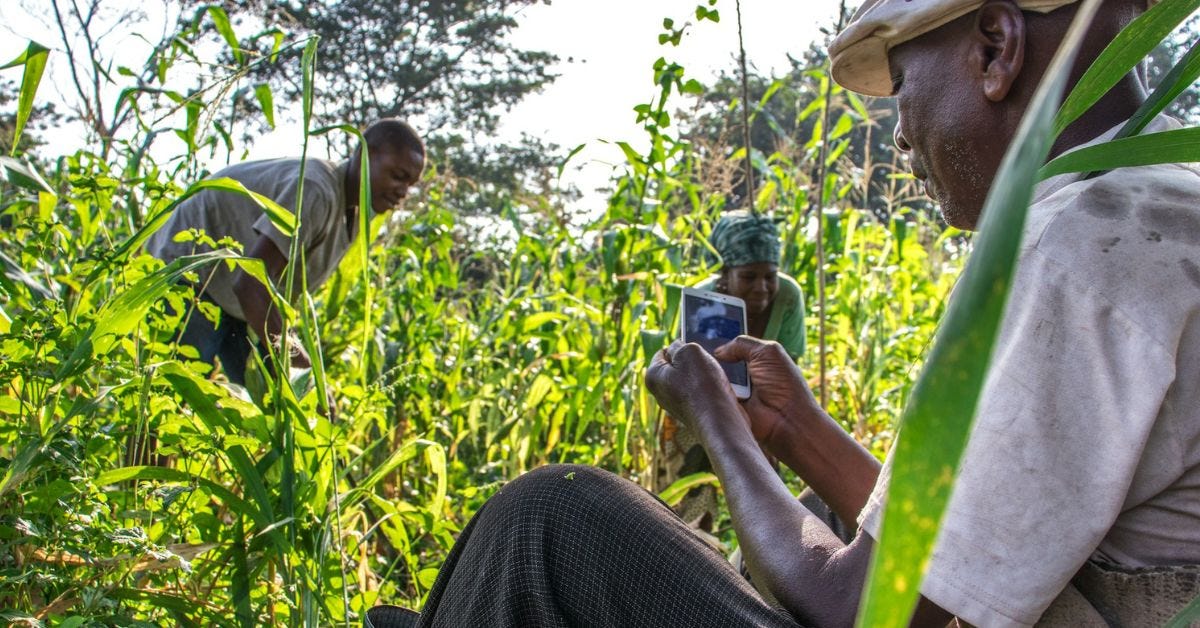
Image source: TechCabal, Gnim Zabdiel Mignake on Unsplash.
Brastorne’s core service suite includes mAgri, which provides farmers with market information, trading opportunities and agricultural advice, Mpotsa, an interactive voice and SMS service delivering localised content on health, education and employment, and Vuka, a social communication service tailored for feature-phone users.
Why it matters
Cross-border scaling remains rare in African agritech. Brastorne’s move suggests its telco-enabled model can extend beyond its home market. Alongside players such as OKO, which also partners with Orange, and regional expanders like Pula, SunCulture and Hello Tractor, it signals a small but growing group of regional players building operations across multiple African markets rather than remaining single-country focused.
12/02/26
Nigeria’s met agency, Tomorrow.io pilot climate advisory for 100,000 farmers
The Nigerian Meteorological Agency (NiMet), in partnership with weather intelligence company Tomorrow.io and MTN Nigeria, has begun piloting its Digital Climate Advisory Service, targeting 100,000 smallholder farmers across six zones.
The programme will initially deploy SMS-based advisories before expanding to voice services and strengthening extension agents with high-quality forecast information. The rollout marks the first field deployment following last year’s partnership announcement.
Why it matters
A live pilot marks an important step from partnership to implementation. If successful, mobile-based, weather-driven advisory could strengthen climate resilience for Nigeria’s largely rain-fed smallholder systems and demonstrate a scalable model for digital climate services.