

Featured stories
26/09/25
Tanzania’s MazaoHub raises $2M to scale soil analytics and climate-smart farming
Tanzanian agritech MazaoHub, a data-driven company specialised in hyperlocal soil analytics, has raised an oversubscribed USD 2 million pre-seed round. The funding includes USD 1.5 million in equity led by Catalyst Fund, with participation from Nordic Impact Funds, Mercy Corps Ventures, elea Foundation, Impacc, and DOB Equity. A further USD 500,000 in non-dilutive capital came from the Livelihood Impact Fund, highlighting growing investor interest in blended finance models that address climate adaptation.
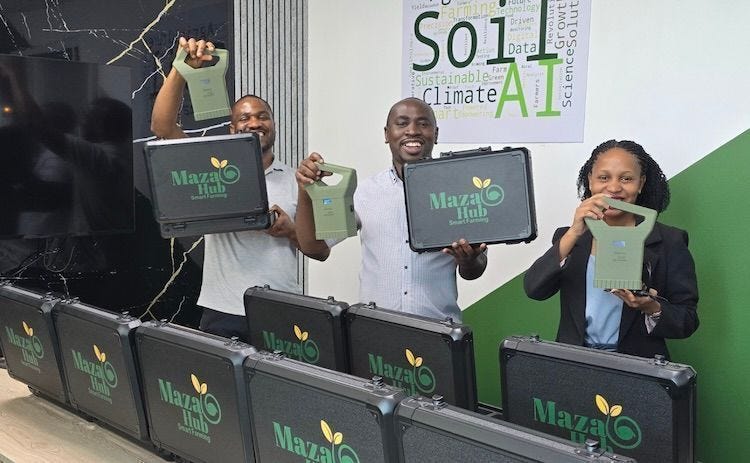
Photo credit: MazaoHub
MazaoHub’s “Tech and Touch” model combines AI-powered soil intelligence with in-person support to help farmers make data-driven decisions and improve market access. According to data released in June, the company has scaled its Farmer Excellence Centers (FECs) to more than 350, serving 54,000 farmers, including 22,000 women. The centers have facilitated around 280,000 soil tests, reduced synthetic fertiliser use by 30%, increased organic manure use by 500%, and boosted average yields by 150% per hectare.
The new capital will fund expansion to 24 regions in Tanzania and, over time, into Kenya, Rwanda, and Zambia. MazaoHub aims to serve over 100,000 farmers, with a strong focus on women and youth agronomists.
In June, the company also secured follow-on investment from Nordic Impact Funds to accelerate nationwide growth.
01/10/25
OKO secures six-figure funding for mobile-based crop insurance across Africa
Agri-fintech startup OKO has secured a six-figure bridge funding round led by Catalyst Fund, with additional backing from existing investors. Incubated in 2018, OKO offers digitally enabled crop insurance via mobile phones, protecting smallholders from the consequences of drought and flood. OKO uses index-based insurance, meaning that claims are automatically validated and claimed if satellite data shows that weather conditions are detrimental to agricultural activities.
OKO currently operates in Ivory Coast, Mali, Uganda, Mozambique, and Angola, with more than 33,000 farmers insured to date. The company reports that all validated claims have been paid, strengthening trust among both customers and institutional partners.

Photo credit: OKO
The new capital will be used to expand collaborations with financial institutions, agritechs, and agribusinesses, integrating automated climate insurance into agricultural value chains. This aims to reduce exposure to weather volatility for both farmers and commercial partners.
The round remains open for one to two additional strategic investors, with the funding expected to accelerate OKO’s efforts to scale climate resilience solutions across Africa. OKO aims to reach 1 million farms by 2027.
Other news
25/09/25
Satyukt partners with Volt to bring satellite-powered farming to Kenya
Indian agritech startup Satyukt Analytics has formed a strategic partnership with Kenyan agritech company Volt Harvest Technologies to deploy satellite-powered agricultural intelligence in the country.
Under the partnership, Volt Harvest will deliver Satyukt’s suite of remote sensing and analytics solutions, including crop stress detection, input optimisation, and risk assessment, to farmers, agribusinesses, and financial institutions across Kenya, enabling more accurate yield forecasting, reduced input waste, and better-informed lending and insurance decisions. Volt operates the ShambaSync platform, which provides real-time farm diagnostics and intelligence services to local farmers.
The collaboration represents Satyukt’s formal entry into the Kenyan market under its Exclusive Partnership Program, with the goal of leveraging local networks to scale the technology. Founded in 2018, Satyukt offers a suite of software as a service (SaaS) products spanning digital advisory services and agri-digital financial solutions. The startup is backed by NABVENTURES, the venture growth equity fund supported by NABARD (National Bank for Agriculture and Rural Development).
28/09/25
India’s DeHaat reports profit in FY25 after previous year loss
Indian agritech platform DeHaat swung to a profit of INR 3,690 million (USD 44.5 million) in FY25 after posting a loss of INR 11,330 million (USD 136.5 million) the previous year. The shift reflects both stronger operating discipline and a one-time accounting gain of INR 5,760 million (USD 69.4 million) from asset revaluation. While this adjustment inflated the bottom line, the company also managed to grow sales and cut costs, signalling improved efficiency after a difficult year.
Revenue rose by 12 percent to INR 30,100 million (USD 362.7 million), supported by higher trading volumes and a wider service footprint. At the same time, expenses dropped by almost a third to INR 26,710 million (USD 321.8 million), largely due to tighter procurement and operating controls. Exports, which involve selling aggregated farm produce to international buyers, added INR 4,300 million (USD 51.8 million), and the company is aiming to nearly double this contribution in FY26.
Founded in 2012, DeHaat is India’s largest digital agri-food marketplace. The company operates across 12 states through a “phygital” model, supported by more than 18,000 DeHaat Centers, 90 hubs, and partnerships with Farmer Producer Organisations (FPOs), serving about 13 million farmers. It provides access to agricultural inputs, advisory services, and market linkages, and also exports produce to 32 international markets. In April 2025, as reported by ArisTechia, DeHaat completed a USD 23.4 million debt funding round to support expansion beyond India.
22/09/25
Spotlight: Farmerline expands Darli AI with multilingual capabilities
Ghana-based agritech company Farmerline has announced new capabilities for its Darli AI farming assistant. Darli AI is a multimodal solution that provides agronomic advice to smallholder farmers in local languages via voice and text. The updated tool can now communicate in 42 languages, answer farmer queries in real time, and diagnose plant diseases and pests through photos taken on mobile phones. It is designed to run on both smartphones and feature phones, widening accessibility for farmers using different device types.

Image credit: Farmerline
A central feature of the upgrade is the integration of 42 Automatic Speech Recognition (ASR) models covering African and global languages, including Akan (Twi), Ewe, Ga, Kiswahili, Yoruba, Zulu, Brazilian Portuguese, and Haitian Creole. Many of these models are already in production, allowing Darli to process and respond to farmers in their own voices and local languages. While accuracy levels vary across models, the expansion marks progress in making AI-driven advisory services more widely available to farming communities.
The upgrade builds on more than a decade of Farmerline’s work in digital agriculture. According to Farmerline, Darli AI has supported over 1 million users. The agritech claims that, to date, Darli AI has handled 8.5 million interactions and calls, and more than 6,000 smartphone empowered farmers have engaged with the chatbot via WhatsApp.
Founded in 2013, Farmerline operates an end-to-end digital agriculture platform and works with agribusinesses, cooperatives, farmer groups, government bodies, and NGOs to reach farmers mainly in West Africa. According to the latest available data, the company has raised approximately USD 15 million to date.
19/09/25
Good Reads: GSMA AgriTech Accelerator reaches 335,000 farmers, drives startup funding across LMICs
The GSMA has published a new report detailing the results and impact of its AgriTech Accelerator initiative, which supported digital agriculture startups across Africa and Asia. Over the past two years, the Accelerator helped agritechs reach more than 335,000 farmers, with 89% reporting improved access to digital agricultural services and over 100,000 women farmers benefiting directly.
During the two-year period, the Accelerator hosted more than 20 product iteration workshops (PIWs), leading to the development and launch of three new agritech solutions. Six participating startups collectively raised USD 1,379,000 in follow-on funding, a figure that has since increased following OKO’s recent six-figure funding announcement (covered elsewhere in this edition).
The ten agritechs selected for the Accelerator were based and operating across West Africa, North Africa, and Southeast Asia, and included eProd, Esoko, FarmSpeak, Greenovator, Jokalante, Moome, OKO, TDX, Winich Farms, and ZR3i.
One key finding of the report is that agritechs most successful in fundraising were those with strong financial models that demonstrated commercial viability and a clear pathway to profitability. A common challenge highlighted was that many founders underestimated the effort required for investor engagement and lacked a clear understanding of effective fundraising. Addressing these gaps, the GSMA provided targeted support to help startups align with investor priorities and communicate compelling value propositions.
The GSMA AgriTech Accelerator was commissioned by the Federal Ministry for Economic Cooperation and Development (BMZ) as part of the Fund for the Promotion of Innovation in Agriculture (i4Ag) and was carried out by the GSMA on behalf of the German Development Agency (GIZ).