

Featured story
16/12/25
Airtel Africa and SpaceX to launch direct-to-cell connectivity
Mobile operator Airtel Africa and SpaceX’s Starlink are rolling out direct-to-cell satellite connectivity across 14 African countries, beginning in 2026. The technology will allow smartphones using standard LTE (4G), where spectrum and regulatory approvals permit, to connect directly to satellites beyond the reach of terrestrial mobile networks, extending data services to remote and underserved rural areas.
Under the partnership, SpaceX will provide Airtel Africa with access to its network of +650 next-generation low-Earth orbit satellites, designed to deliver broadband speeds up to 20 times faster than earlier satellite systems.

Photo credit: Airtel
Agritech is among the sectors expected to benefit most from direct-to-cell connectivity, as it improves data access in areas where farmers, cooperatives, and agri-entrepreneurs often face persistent coverage gaps. Many AI-driven agriculture applications, including image-based crop diagnostics, pest detection, and digital advisory services, are already designed to operate offline or semi-offline. More reliable connectivity enables these tools to sync data more consistently, receive updates, and scale more effectively, even where bandwidth remains limited.
Airtel Africa currently serves 173.8 million customers across the continent. Starlink is currently reaching more than 11 million customers with its direct-to-cell satellite service.
01/12/25
DigiFarm launches Jipange cash advance for tea farmers
Safaricom’s agritech platform DigiFarm has launched a new financial product, Jipange Cash Advance, to help tea farmers in Kenya address short-term cashflow gaps caused by delayed factory payments.
Developed in partnership with Access Bank Kenya and local tea factories, Jipange enables farmers to receive funds in advance of scheduled payouts by providing instant credit via mobile money. It aims to strengthen liquidity and financial resilience for smallholders who typically wait weeks or months between harvest and payment.
The facility removes the need for collateral by advancing funds based on verified tea deliveries, with access provided through Safaricom’s *USSD platform (944#) and mobile money service M-PESA. Repayments are automatically deducted once the factory completes its payment cycle.
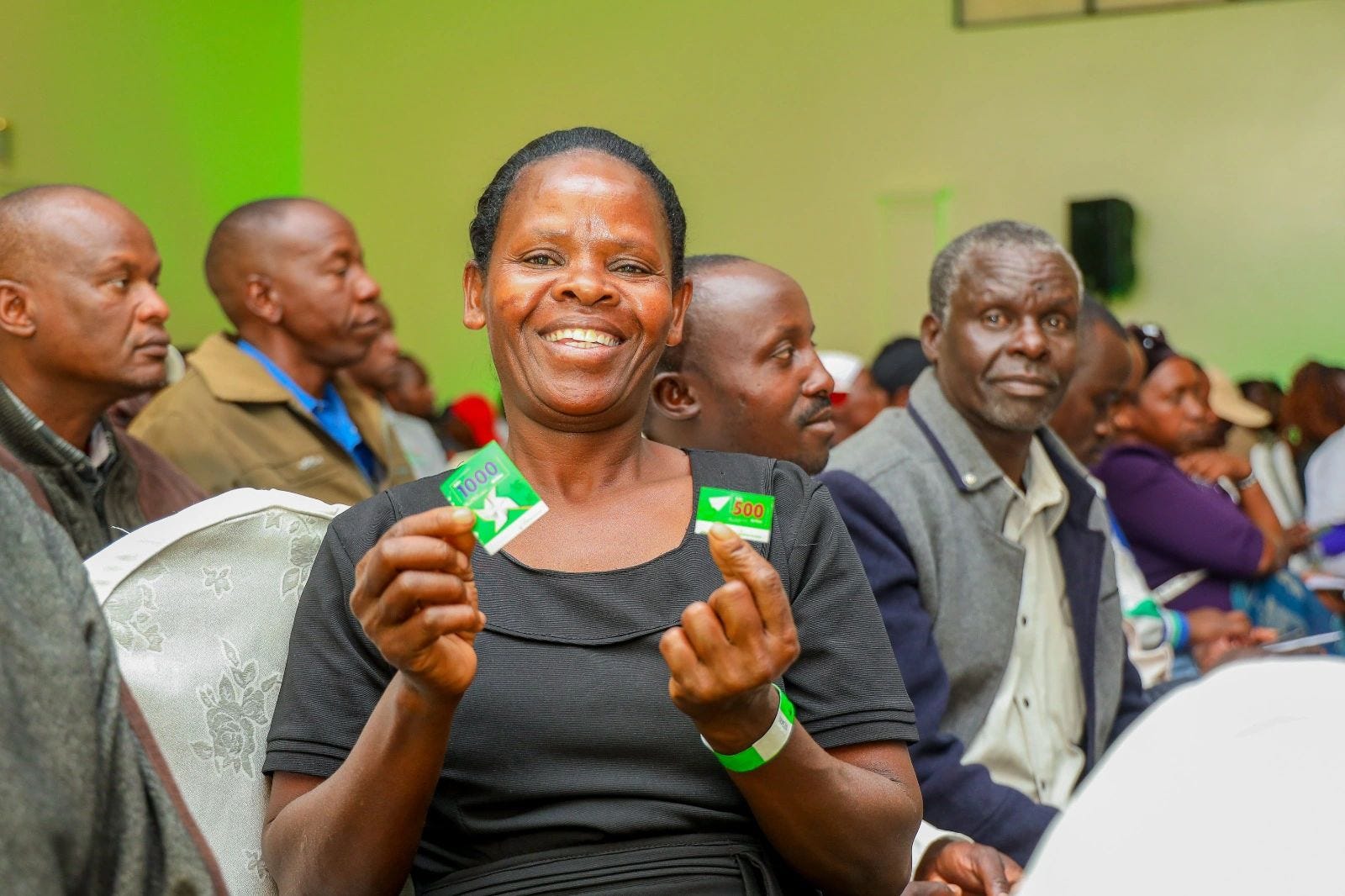
Photo credit: Safaricom
Jipange has been piloted across four tea factories in the Rift Valley region, with plans to scale the product to all eligible smallholder tea farmers countrywide and extend similar solutions to other value chains such as dairy.
Tea remains a key economic activity in Kenya, supporting nearly one million farmers and contributing around 2-4% to the national GDP and 20-26% to export earnings, while underpinning the livelihoods of more than 6.5 million people.
Established in 2018, DigiFarm provides smallholder farmers with access to agronomic information, input financing, and market linkages through Safaricom’s mobile and data infrastructure. DigiFarm has kept a relatively low public profile. The latest figures from Safaricom’s Sustainability Report published last October indicate that +980,000 farmers have registered on the platform.
9/12/25
UAE launches $200M AI for Agriculture Ecosystem to support smallholders
The United Arab Emirates has launched the AI for Agriculture Ecosystem, a multi-partner platform aimed at accelerating the use of artificial intelligence to support smallholder farmers in climate-vulnerable regions.
The Ecosystem builds on a USD 200 million partnership between the UAE and the Bill & Melinda Gates Foundation, announced at COP28, and focuses on leveraging Abu Dhabi’s research base, talent, and AI capabilities to strengthen agricultural resilience in low- and middle-income countries.
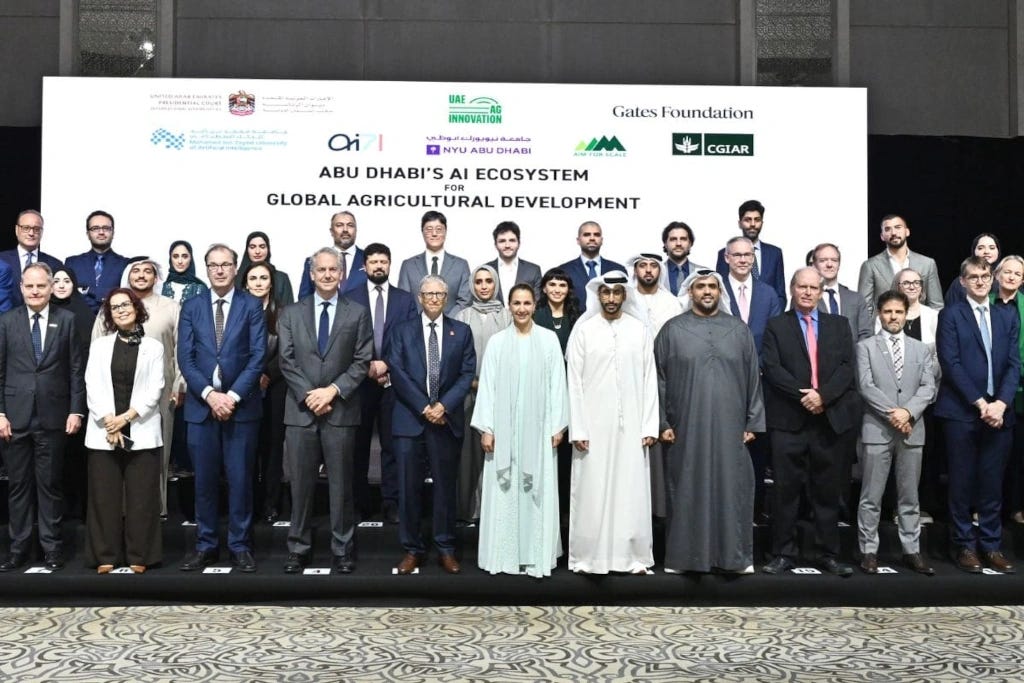
Photo credit: CGIAR
The Ecosystem brings together four initiatives: the Institute for Agriculture and Artificial Intelligence (IAAI), the CGIAR AI Hub, AgriLLM, and the Agricultural Innovation Mechanism for Scale (AIM for Scale).
The IAAI, based at Mohamed bin Zayed University of Artificial Intelligence (MBZUAI), provides digital advisory tools, training, and technical assistance to governments and NGOs.
The CGIAR AI Hub, hosted in Abu Dhabi with AI company ai71 as a core partner, serves as a global collaborative workspace for applied agricultural AI.
AgriLLM, an open-source model developed by ai71, supports agricultural intelligence, while AIM for Scale, based at New York University Abu Dhabi and jointly funded by the UAE and the Gates Foundation, focuses on scaling AI-powered weather and advisory services for smallholder farmers.
At COP30, AIM for Scale announced an ambition to reach 100 million farmers by 2030, building on progress made in 2025, when AI-powered monsoon forecasts were delivered via SMS to 38 million farmers in India.
From 2026, activities are expanding to Bangladesh, Chile, Ethiopia, Kenya, and Nigeria, with plans to reach 25 additional countries by 2027.
15/12/25
Agrilever and Tomorrow.io partner for AI-weather forecasting for Filipino rice farmers
Philippine’s agritech Agrilever, an agri-fintech focusing on smallholder rice farmers, has partnered with weather intelligence provider Tomorrow.io to expand hyperlocal, AI-powered weather forecasting in the country. The collaboration aims to help farmers and government agencies manage climate risks amid increasingly variable weather conditions.
Agrilever’s farmer platform will provide real-time, hyperlocal insights powered by Tomorrow.io’s forecasting system. The platform consolidates digital crop protocols, weather intelligence, and access to financing tools, giving farmers information and support to make timely field decisions.
As Tomorrow.io’s local partner, Agrilever has provided wether intelligence solutions to local government agencies such as the Department of Agriculture and the National Irrigation Administration (NIA), supporting early warnings and operational planning during recent typhoons.
The Philippines ranks 7th globally in the Climate Risk Index for 1995–2024, with 371 extreme weather events, 27,500 fatalities, and more than USD 35 billion in economic losses over that period.
During Typhoon Uwan, Agrilever and Tomorrow.io provided weather coverage for affected provinces in Luzon and the Visayas through NIA’s rice irrigation system, enabling regional units to anticipate field conditions that influence planting schedules and water management.
Good reads (what ArisTechia is reading..)
16/12/25
Caribou and Mastercard plan to drive impact through agri-influencers and social agriculture
Research and advisory firm Caribou has published a new report in partnership with the Mastercard Foundation, Building the Agri-Influencer Network: Lessons from a Pan-African Youth-Led Learning Community. The report draws on two years of participatory action research with 24 young agriculture leaders and content creators across 11 African countries.
These agri-influencers (farmers, processors, traders, and advocates) combine hands-on agricultural experience with strong digital skills. Collectively, the Agri-Influencer Network reaches more than five million people across major social media platforms, helping make agriculture more visible, accessible, and relevant to young audiences.
The findings show that the network’s influence spans trusted information exchange, expanded market access, and stronger peer networks. Agri-influencers translate complex agricultural knowledge into practical guidance, open pathways to digital markets, particularly for youth and women,and build trusted communities for learning and connection.
Building on these findings and Caribou’s broader work on social agriculture, the report outlines the next phase of the Agri-Influencer Network as it moves from a pilot to a pan-African platform.
This next phase will focus on measuring impact, strengthening sustainability and governance, deepening strategic partnerships, and positioning agri-influencers as trusted guides within the digital agriculture ecosystem.