

A new GSMA report examines how AI is improving agricultural advisory services, financial inclusion and market access for smallholder farmers in Indonesia. Based on 200 interviews and field testing across Jakarta, Yogyakarta, Aceh and Bali, the study identifies three AI applications combining the strongest impact potential with near-term scalability: conversational agricultural advisory, AI-enabled alternative credit scoring and AI-driven price prediction and market intelligence.
The findings suggest that digital advisory delivered through familiar channels such as WhatsApp, alongside AI-enabled financial inclusion models, offers one of the clearest pathways for investment and scale. Digital farm management and agri e-commerce platforms also create value, particularly around farmgate pricing and market forecasting, although standalone apps and web interfaces continue to face adoption barriers linked to trust and usability.
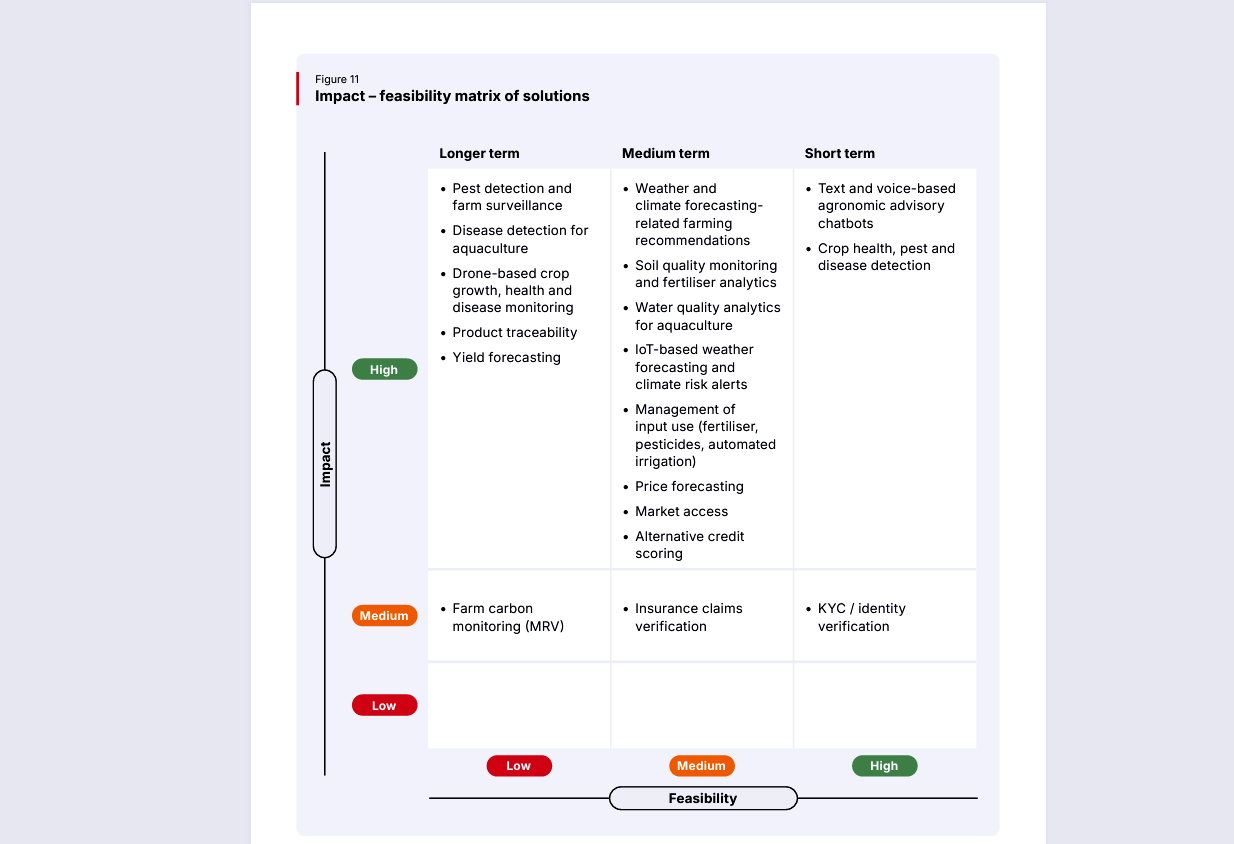
Image credit: GSMA Mobile for Development
The report also highlights emerging opportunities in carbon monitoring, reporting and verification (MRV), product traceability, increasingly driven by European Union Deforestation Regulation (EUDR) requirements, and drone-enabled precision agriculture. However, weak data infrastructure, limited institutional support and high capital requirements continue to constrain adoption, with investment needs often exceeding what startups and smallholder ecosystems can absorb without external financing.
Indonesia’s agritech ecosystem remains highly active, with startups, academia and public-sector initiatives continuing to experiment with digital agriculture models. Companies including Elevarm, Eratani, Pandawa Agri, JALA, Banyu and Rize, many with AI-enabled offerings, have recently attracted investment.
Smallholder farmers account for an estimated 25.6 million households, representing 90% of Indonesia’s 28.4 million agricultural households, while agriculture contributes around 14% of national GDP.