

One of the most interesting articles I read this week (thanks to Vikram Kothari for sharing it on LinkedIn) wasn’t about a breakthrough AI model or another agritech funding round. Instead, it highlighted something less visible: the emergence of multilingual AI infrastructure as a foundational capability for digital agriculture.
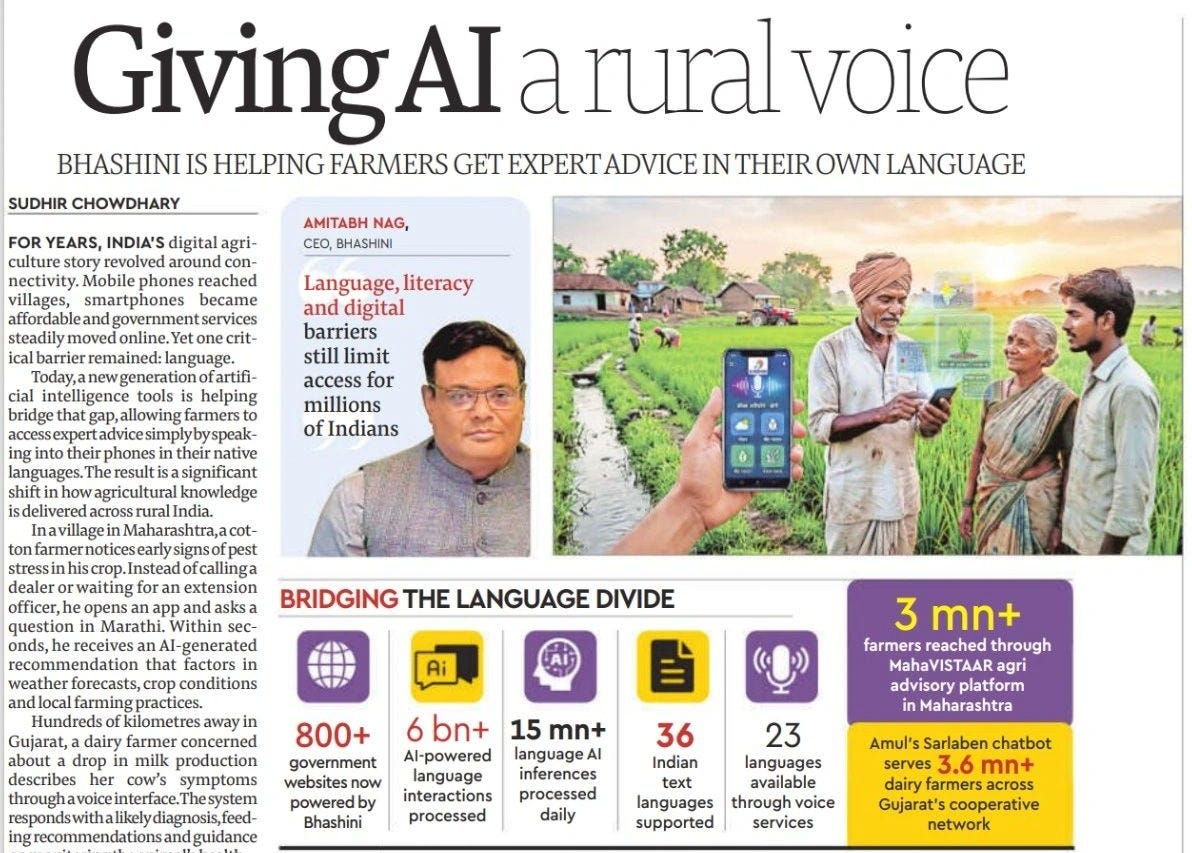
Source: Financial Express
At the centre of the story in the Financial Express newspaper is BHASHINI, a flagship initiative under India’s Digital India programme and National Language Translation Mission. Rather than building another farmer-facing application, BHASHINI provides a shared language layer that enables voice and text interactions across 23 Indian languages, supports 36 text languages, powers more than 800 government websites, and processes over 6 billion AI-powered language interactions and 15 million AI inferences every day.
The platform is already being embedded into agriculture at scale. Maharashtra’s MahaVISTAAR, a multilingual educational and advisory platform for farmers, combines crop guidance, weather intelligence, market prices and government schemes into a single AI-powered advisory service reaching more than 3 million farmers. In Gujarat, the Amul Sarlaben is a localised AI-powered dairy assistant offering personalised advice on animal health, nutrition, breeding and milk production to 3.6 million dairy farmers across 18,500 villages.
What caught my attention is that BHASHINI is not an agricultural platform. It is a shared capability that sector-specific services can plug into, allowing farmers to interact naturally in their own language rather than adapting to a new interface. The initiative can be described as attempting for language what Digital Public Infrastructure (DPI) has achieved for identity and payments: creating a common, reusable capability that supports an entire ecosystem instead of being rebuilt by every application.
Viewed alongside AgriStack, which provides digital farmer identities and agricultural data, and the Krishi Decision Support System, which delivers geospatial and agronomic intelligence, BHASHINI appears to add another layer to India’s evolving digital agriculture architecture.
Whether this approach ultimately translates into better outcomes for farmers remains, as always, to be seen. Adoption, governance, interoperability and institutional coordination will matter as much as the technology itself. But the idea of treating multilingual AI as shared infrastructure, rather than as a feature of individual applications, is an interesting one, and a model worth watching beyond India.