

Last week saw the publication of the annual milestone report by AgFunder on global agri-food tech investment. Bain & Company also published their 2024 report on venture capital in India, a comprehensive overview of the VC landscape in the country.
The report was released just days before the Startup Mahakumbh event, the largest to date event dedicated to startups in India, which concluded yesterday in New Delhi and saw the participation of PM Narendra Modi.
Both reports reflect the overall global caution on risk capital, referred to as the funding winter or the “funding freeze”, and highlight how agritech was not immune, but they also share optimism for the sector.
Key factors supporting a positive outlook in emerging markets include a shift toward investing in upstream “farmtech” - as in providers of solutions that support on-farm food production (agricultural practices, food production and logistics) – and continuous traction for tech companies developing agribusiness marketplaces (i.e. for inputs) and fintech solutions.
In India, the largest agritech market in low- and middle-income countries (LMICs), the emergence in 2023 of large climate and agri focused funds, such as those announced by domestic VCs Omnivore (USD 150 million) and Avaana Capital (USD 70 million), send signals of cautious optimism.
Here are my highlights from the two reports:
AgFunder: Agri-food-tech investment at its lowest in 6 years, positive outlook for LMICs
AgFunder’s Global AgriFoodTech Investment Report 2024 finds that startups in agri-food tech raised USD 15.6 billion in 2023, the lowest level in 6 years, representing just 5.5% of all venture capital sector investment, down from 6.7% in 2022 and 7.6% in 2021.
AgFunder’s definition of agri-food tech comprises a broad group of subsectors. These include, in the upstream, subsectors such as bioenergy and biomaterials (the biggest category globally in agrifood tech in 2023), farm robotics and mechanisation, and the broad category of agribusiness marketplaces and fintech (a more prevalent category in LMICs). The report also extends to “downstream” startups, such as those that work on consumer facing solutions (i.e. e-grocery marketplaces, online restaurants).
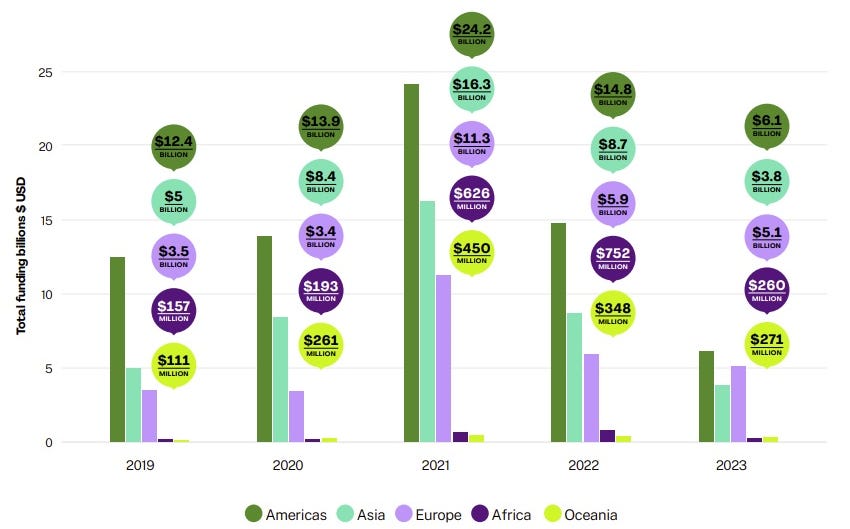
At a regional level, Africa attracted USD 260 million in 2023 across all categories tracked by AgFunder and its data partners. That figure compares to USD 752 million in 2023 and USD 626 million in 2021. However, total investment in the region remained at higher levels than in pre-COVID times, which is not the case for Asia Pacific as whole. Across APAC, agri-food tech reached USD 5.1 billion in 2023, down from USD 5.9 billion in 2022 and USD 11.3 billion in 2021.
Fig. 1: 5 years of agrifoodtech by region ($/USD)
Source: AgFunder
On the positive side, across emerging markets so-called upstream investment totalled in 2023 USD 2.45 billion, and was greater than downstream investment at USD 1.3 billion. This is important because startups operating upstream are those that are impact-driven, as they directly support smallholder livelihoods and inequalities in food systems, and address climate change.
Looking at subsectors, the study highlights that agribusiness marketplaces and fintech are becoming increasingly important to farmers’ livelihoods in emerging markets, primarily in Africa and Emerging APAC. Notable deals for the year 2023 among B2B agri marketplaces included the USD 35 million raised by Kenya’s B2B agri e-commerce Twiga Foods and the USD 46 million raised by India’s Ecozen.
Indonesia’s eFishery carries the flag for emerging market startups. For the second consecutive year, the aquatech, the first agritech unicorn in Indonesia and the only aquatech unicorn globally, held the top deal spot at a global level within the farm robotics and mechanisation subsector, as a result of its USD 200 million Series D that took place across two rounds.
Bain: Agritech likely to attract investor interest in India in 2024
Bain & Company’s India Venture Capital Report 2024 is a yearly publication that looks at the VC landscape in the country. At a macro level, the report highlights the overall decline in deal volume (from 1,611 deals in 2022 to 880 in 2023) and average deal size (from USD 16 million to USD 11 million), reflecting the global funding winter, which in India has been compounded by persistent inflation and high interest rates.
The report authors refer to generative AI as a breakout theme in India, with investments growing to approximately USD 250 million in the year from a nascent base in 2022. This is within the context however of a general deceleration of investments. Only two new Indian unicorns emerged in 2023, grocery delivery Zepto and fintech InCred. That compares to 23 new unicorns in the country in 2022. Nonetheless, in 2023 India maintained its status as the second-largest destination for VC and growth funding in Asia-Pacific.
Looking at agritech, the report includes “sustainability-centric agritech” as one of the themes (together with energy transition) that is likely to attract investor interest in the near-term. According to Bain, this year B2C commerce and software-as-a-service (SaaS) solutions are likely to continue attracting most of the attention.
Optimism in agritech is reflected, continues the report, by the launch of thematic funds by domestic VCs in 2023, such as Omnivore’s agritech and climate sustainability fund, which last year announced a first close at USD 150 million beating its target of USD 130 million. This was the largest thematic fund in India in 2023. It aims to catalyse climate action in agriculture by investing in 25-30 Seed and Series A agritech startups and MSMEs, with ticket sizes ranging between USD 1 million and 5 million.
In second place in the list of the largest thematic funds stands the Avaana Climate and Sustainability Fund, which last year secured a first close of USD 70 million to invest in providers of climate tech solutions, including those working on sustainable agriculture and food systems.
Finally, Bain gives a notable mention to agritech Arya.ag. The startup provides a B2B market linkage platform which embeds financial services for smallholders owing less than five acres. Arya.ag is one of the few “tech-first” start-ups that turned profitable last year. As reported by ArisTechia in November, the startup saw its revenues grew to INR 2.9 billion (USD 34.8 million) in the 2023 financial year representing a 50% increase from the previous year.
We hope you found this analysis piece insightful, and if you do so we are immensely grateful if you could share this through your network. Next we will be back with our news roundup. As usual, thoughts and feedback are welcome.