

Vodacom Group, one of Africa’s largest telecommunications companies, has published its ESG report for the period 1 April 2025 to 31 March 2026, detailing its achievements across a broad portfolio of digital agriculture solutions supporting farmers and agribusinesses.
The group now serves more than 9.9 million registered users, up from 9.6 million a year earlier, through digital agriculture solutions n South Africa, Tanzania, Kenya and the Democratic Republic of Congo (DRC). Together, these solutions support agricultural productivity by improving access to advisory services, finance, insurance, digital payments, markets and agricultural inputs.
At the core of the portfolio is eVuna (formerly Connected Farmer), a B2B2C platform that enables agribusinesses, financial institutions and governments to digitally engage with smallholder farmers. The platform supports farmer registration, advisory services, insurance, market linkages, e-vouchers and specialised applications including dairy management and digital produce reconciliation.
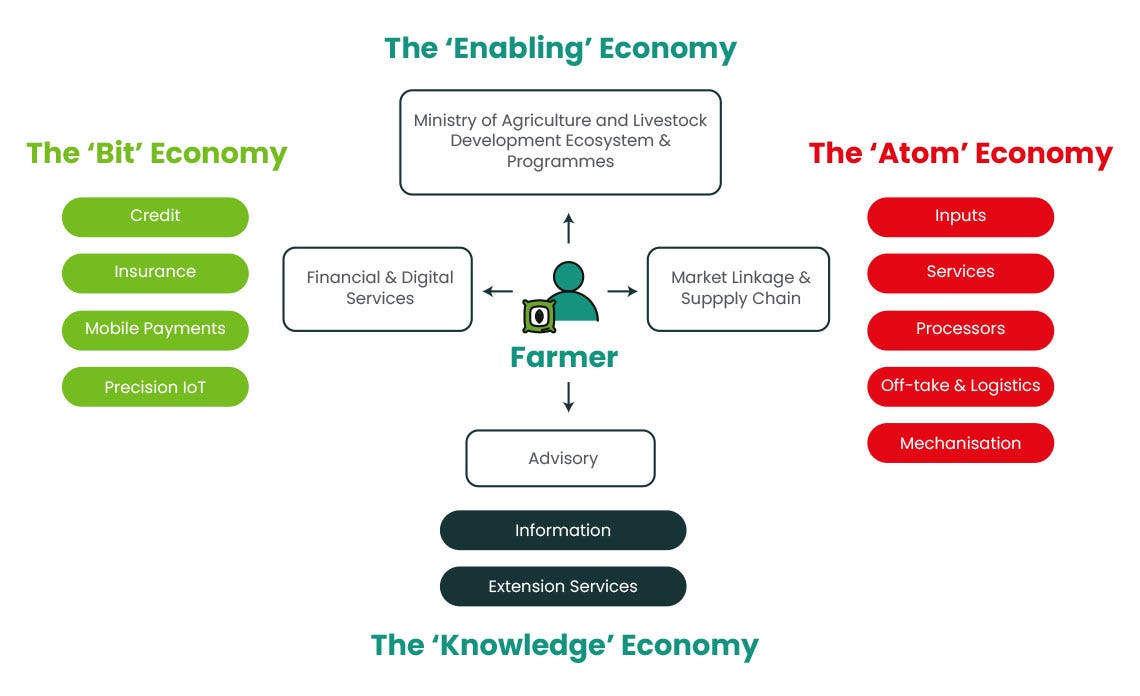
Image credit: Vodacom/Mezzanine
In Tanzania, M-Kulima allows agribusinesses to register farmers digitally, deliver advisory services and make payments through M-Pesa, while partnerships with agricultural cooperatives extend the platform’s reach to rural communities.
The report places particular emphasis on Moloni in the DRC. This is a free service, which provides weather forecasts, sustainable farming advice and a digital marketplace. Vodacom completed a pilot reaching around 10,000 farmers and is now moving into large-scale implementation. As part of a new food security programme in the conflict-affected Kasai region, farmers receive seeds and farming tools through an e-vouchering system before being connected to Moloni to access agronomic advice, climate information and market opportunities. Integration with M-Pesa loans aims to improve financial inclusion, while partnerships with local organisations are expected to support wider adoption of the platform.
Vodacom also offers M-Koba in Tanzania, a digital platform that digitises rural community savings groups. During FY2026, active groups increased from 213,000 to almost 300,000, while total savings grew by 81%. Women account for most participants, underlining the platform’s contribution to financial inclusion.
Why it matters
Vodacom’s results show that digital agriculture can be a long-term strategic capability for telcos, not just a CSR initiative. Through eVuna, M-Kulima and AgriTech Moloni, Vodacom has built a portfolio of agriculture-specific services combining connectivity, mobile money, digital platforms and partnerships.
Its scale, almost 10 million registered users across several African markets, shows the role telcos can play beyond connectivity, especially given their rural reach, trusted brands and payment infrastructure. Vodacom’s early investment in Mezzanine, whose agriculture platform evolved into eVuna, also shows the value of building in-house capabilities rather than relying only on third-party startups.
This model is especially important in more vulnerable countries such as the DRC, where startup ecosystems are less mature and telcos can play a broader role as providers of national digital infrastructure and digital services.