

Weather intelligence is a topic I've followed for many years. Recent advances in AI are opening up new possibilities, particularly for emerging markets, where access to accurate weather information remains a major challenge. But what do these advances actually mean for the people and businesses that rely on this information? In this article, I explore three areas where I believe AI could make a difference.
Highly localised, accurate weather information is crucial in tropical regions with high climate variability and increasingly unpredictable weather patterns. One study across six African countries found that, in a typical year, around a third of farms were affected by extreme weather events, reducing national crop production by an average of 29%.
Two recent developments show how quickly AI-powered weather intelligence is advancing: the OpenAI Foundation is backing a USD 60 million initiative targeting weather and crop-disease forecasting for 100 million farmers, while Google Deep Mind, the main AI R&D lab of Google, has released a new version of its WeatherNext AI forecasting technology with forecasts at resolutions of up to 5 km.
But what does AI actually change for weather intelligence? AI can help address some of the structural weaknesses that have made accurate, localised weather intelligence particularly difficult in LMICs. I see three areas where it could make a particularly important difference.
1. Doing more with sparse observational data
Ground-truth observations are a fundamental ingredient of weather forecasting, but many African and other LMIC markets have much thinner networks of functioning ground weather stations. This creates something of a paradox: some of the places where accurate weather intelligence matters most are also those where weather is highly variable and the underlying observational infrastructure is weakest.
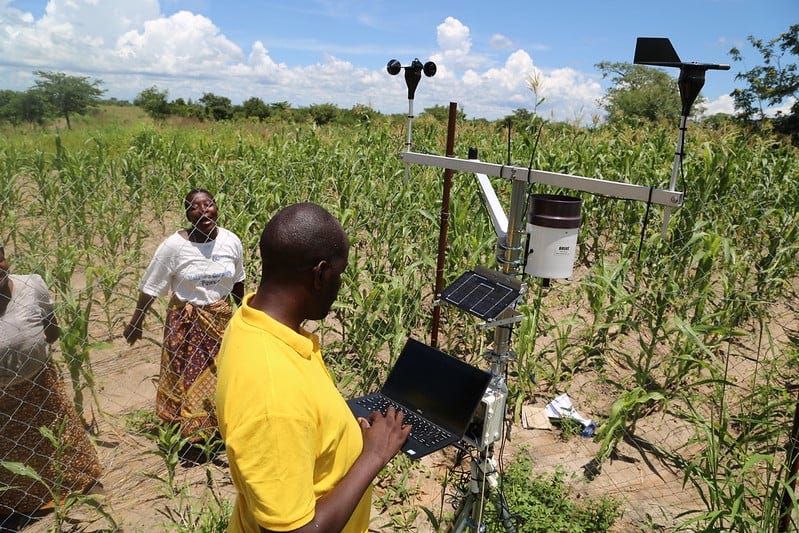
Photo credit: Flickr
AI cannot eliminate this data gap, but it can help make much better use of the data that are available, combining satellite observations, weather-station data and other sources in new ways. Google DeepMind’s WeatherNext 3, for example, directly ingests live satellite imagery, allowing it to generate a new forecast every hour. It also trains directly on sparse weather-station observations, helping it produce more localised predictions even where observational networks are limited. This is particularly important in parts of Africa, Latin America and Asia-Pacific that have historically lacked access to high-resolution forecasting because of the cost of traditional regional models.
Another emerging opportunity is synthetic data: artificially generated data that can supplement limited real-world observations when training AI models. Used carefully, synthetic data could help address gaps in datasets where observations are expensive, geographically uneven or simply unavailable. Weather intelligence company Ignitia, for example, has used synthetic data to help train its AI models in regions where observational data are sparse. It cannot substitute for real observations, particularly where models need to be validated against highly variable local conditions, but it could become another tool for building useful models in data-scarce environments.
Ground observations remain critical, particularly in highly variable tropical climates, for validating whether increasingly sophisticated models actually work in local conditions. For this reason, investment in observational infrastructure should remain a priority. Initiatives such as the Systematic Observations Financing Facility (SOFF), a UN fund supporting countries to expand and sustain weather and climate observation networks, have an important role to play. Better AI models and better observational infrastructure need to develop in parallel.
2. Producing much more granular forecasts, at much lower computational cost
The second opportunity is granularity. High resolution is the key word, but historically it has come at a cost. AI dramatically reduces the computational requirements of sophisticated forecasting. Earlier Google DeepMind models could generate global forecasts in under a minute on a single specialised processor, compared with hours of computation on hundreds of machines for traditional physics-based models. This matters particularly in emerging markets, where the supercomputing costs of running high-resolution regional models have historically limited the availability of localised forecasting.
There is a related, broader lesson here for AI in Africa. Much of the global AI race has been associated with ever-larger models, datasets and computing requirements. But in environments where both data and computing resources are constrained, smaller and more specialised models can offer another route. The work around African language AI offers an interesting parallel: Lelapa AI, for example, has developed smaller language models for African languages, while initiatives such as Masakhane are building models and datasets for languages poorly represented in mainstream AI systems. Rather than simply replicating the scale of global models, the opportunity is to design AI around the data, infrastructure and problems that exist locally.
WeatherNext 3 can now forecast some surface variables at resolutions of up to 5 km and generate forecasts every hour. This matters because the value of weather intelligence often depends on how precisely a forecast can answer a local question.
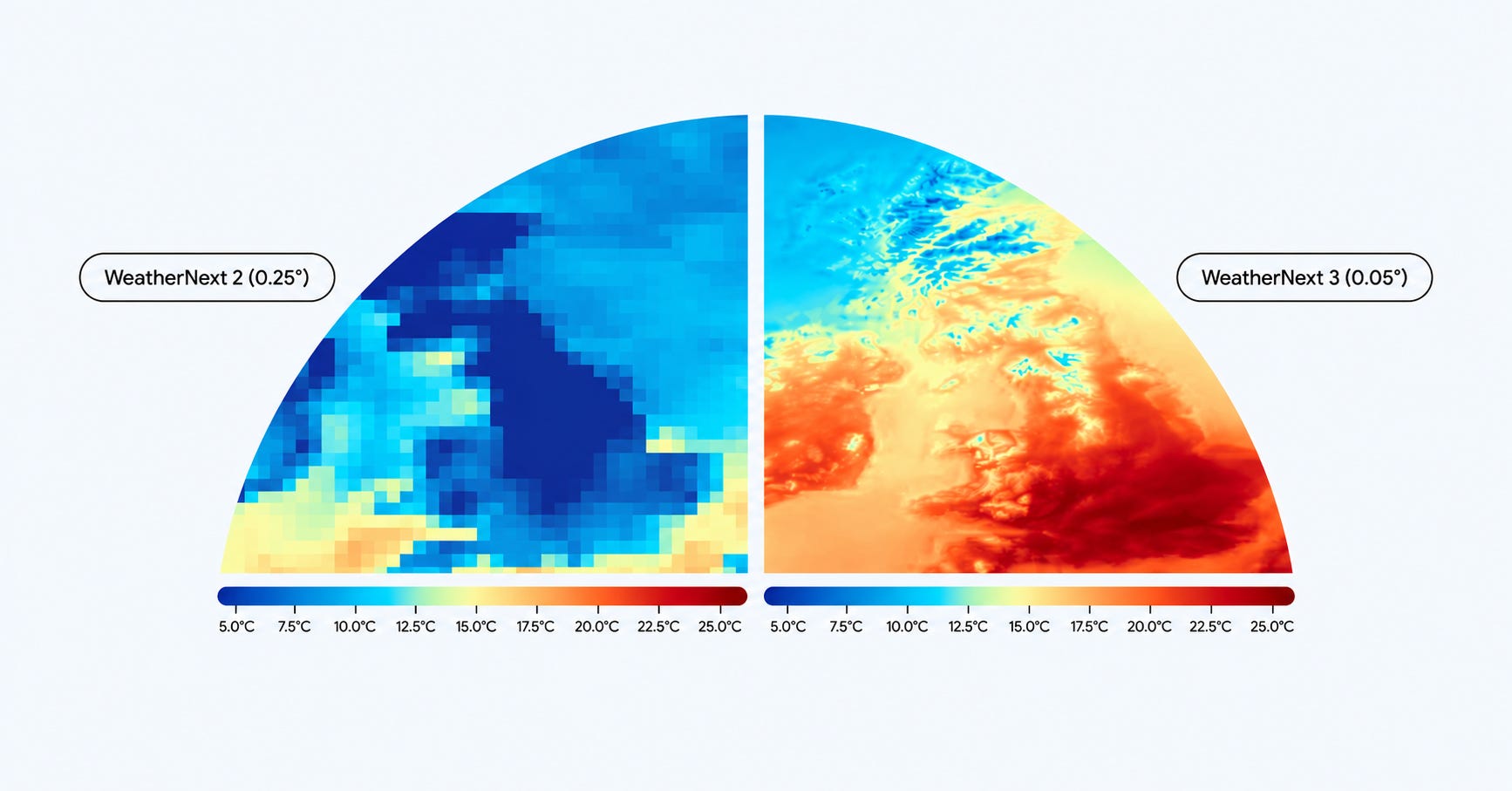
WeatherNext 3 uses a five-kilometer grid for surface temperature, picking up mountain ranges and coastlines that blur into blocky shapes in WeatherNext 2's 25-kilometer grid. Image credit: Google DeepMind
Agriculture provides an obvious example. A farmer does not simply need to know whether rainfall is expected across a region or even a district of Kenya. The useful question is whether it is likely to rain sufficiently in a particular location over the next few days to justify planting. Ignitia has been working on this localisation challenge for years, using machine learning and meteorological and satellite data to generate highly localised forecasts specifically for tropical climates, where weather conditions can vary substantially over relatively short distances.
But the same principle extends well beyond agriculture. Renewable-energy operators, for example, need to anticipate local wind, cloud cover and solar radiation (variables explicitly included in WeatherNext 3 for renewable-energy applications). Governments and humanitarian organisations need better information about where extreme rainfall or heat is likely to hit. Insurers and financial institutions need increasingly granular information to understand physical climate risks. Logistics companies, infrastructure operators and businesses making decisions about supply chains all have exposure to weather.
3. Turning forecasts into actionable intelligence
Better models aren’t enough. The third opportunity, and perhaps the most important, is moving from weather forecasts to weather intelligence. A more accurate forecast has limited value unless it can be translated into a decision: whether to plant, issue an early warning, alter a delivery route, protect an asset, adjust energy generation, price risk or manage exposure.
This is ultimately about the long-standing issue of user-centred design, a recurring theme in Tech for Development. Few would dispute its importance, but then it is too often forgotten in implementation, particularly when excitement around new technologies shifts attention towards what the technology can do rather than what users actually need.
The starting point should not be what information increasingly sophisticated AI models can produce, but what decisions users need to make and what information will help them make those decisions. A technically superior forecast will have little practical value if it is delivered at the wrong time, at the wrong geographic scale, through an inaccessible channel or in a form that users cannot easily translate into action.
Transforming forecasts into “actionable intelligence” is the critical layer of innovation between increasingly powerful weather models and the organisations and individuals that ultimately need to act on their outputs.
TomorrowNow is an example of what this can look like in practice. It is integrating Google’s AI weather models with crop, location and agronomic information to turn forecasts into practical recommendations for farmers. The question is no longer simply “Will it rain?”, but “Are conditions suitable for planting now?”
TomorrowNow is also building a network of ground weather stations across East and Southern Africa to validate AI-powered forecasts against actual local conditions. That is an important reminder that AI does not make traditional weather infrastructure irrelevant. AI models, satellite data and ground observations increasingly need to work together.
Agriculture is one of the clearest applications, because the relationship between weather and individual decisions is so immediate. But the same model applies elsewhere: increasingly powerful general forecasting models can be combined with local data and sector-specific knowledge to translate their outputs into actionable intelligence.
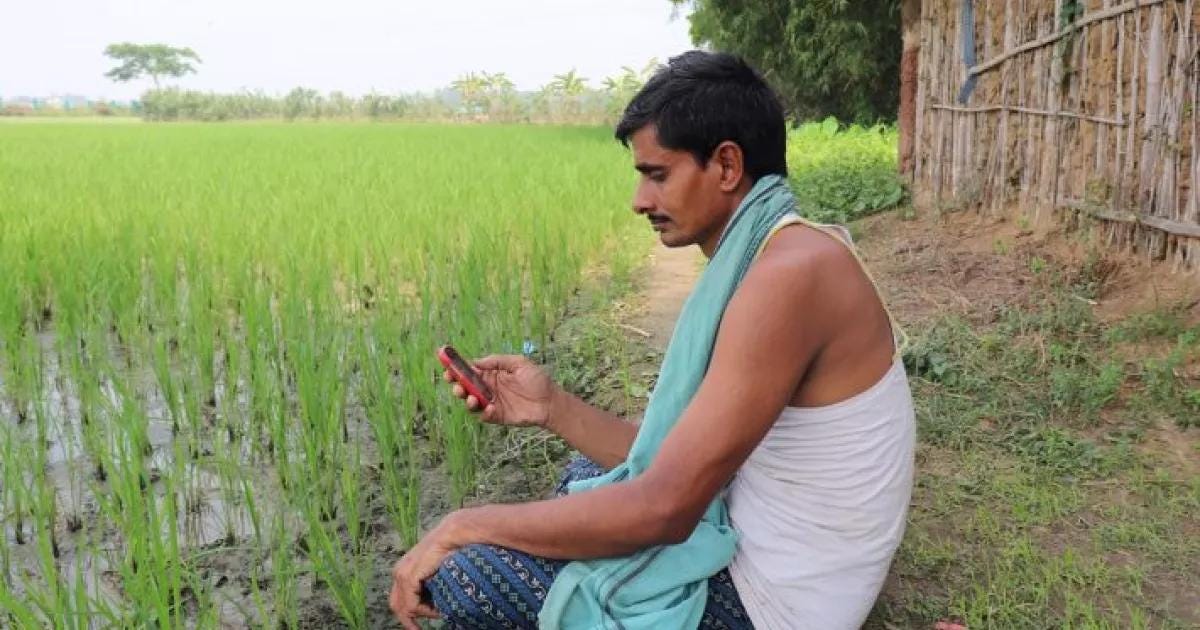
Photo credit: CGIAR
For financial services, better weather intelligence could improve climate-risk assessment, parametric insurance, credit decisions for climate-exposed businesses and the design of financial products that help households and MSMEs anticipate and respond to climate shocks. For governments and development organisations, it could strengthen early-warning systems and disaster preparedness; for energy providers, it could improve forecasting of renewable generation and demand.
The opportunity for AI lies not only in predicting the weather more accurately, but in getting much more value from the weather data that are available: combining satellite, ground and modelled data to produce more granular forecasts, and designing applications that translate those forecasts into decisions. AI does not remove the need for better observational infrastructure, but it could make gaps in that infrastructure less constraining. Ultimately, the next frontier is making increasingly powerful predictions more useful to the people, businesses and institutions whose decisions depend on them.
A common theme among new Ag tech conversations is data provenance and getting the tech into farmer's hands. It is also true that they are understandably reluctant to turn over anything of value to corporations based on a smile. In these moments, as in disaster, the sole expert in the universe on what's needed is that individual. Yet, in all of the current paradigm of systems, the individual is not a central design theme. When we do this however, everything you describe as challenges are solved instantly. When the entire sovereign being is secured and given a means to exchange value, extremely complex behaviors can arise from a very few well designed parts.
https://github.com/has-needs
https://omdesign.is/has-needs
Has-Needs is a personal 'receipt chain' that only records value exchanges. Sovereign beings are able to join into groups easily and for any purpose, with concentric layers of security.
Designed to mitigate trauma by empowering individuals in collective action, everything about your identity and your interactions can be verified as a granular fact, rather than the extractive pattern today. Has-Needs, as a "self-owned and collectively verified" resource, allows everyone to capture value from anything they 'are' without giving anything away. When the individual is verifiable, then everything they add to the system can be considered 'valid' and can be easily cross checked. The result is efficiencies and trauma reduction at every level.
Because Has-Needs is funded from 5% of governmental savings during a disaster, and free to people, always... then the self-ownership and composable API allow anyone to stream or consume data and get value in exchange. Farmer's can 'sell' to governmental and academic players, or 'trade' it to neighbors for regional microclimate and early warning of hail - as an Ag example.
The substrate that manages identity exposure, community management, verification in disaster is naturally excellent at coordinating regular life too. Has-Needs is unique in all the world right now, after 15 years of development, born from a confluence of geology and sociology, it's time has come.
The major benefits in disaster are offline first coordination and self-efficacy.
For refugees, Has-Needs represents portable proof of training, skills, education - which are priceless in bypassing xenophobia altogether.
In regular life, some major benefits are protection of community wisdom, and individual sovereignty - which instantly reconfigures a number of important relationships with commerce and governance.